
 Kontakt
 Jak kupować

Dostawa
Doradca ds. zakupów
AI Economics
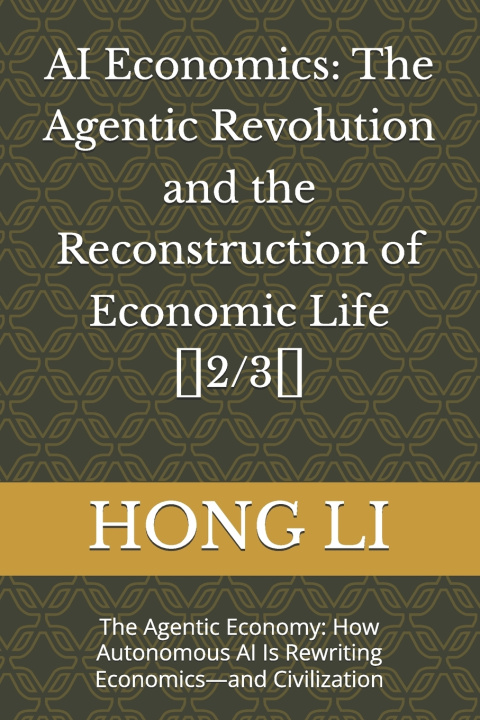
The Agentic Revolution and the Reconstruction of Economic Life (2/3): The Agentic Economy: How Autonomous AI Is Rewriting Economics-and Civilization
 Angielski
 324 b
 Zapowiedź
 Nowość
Nawet do 30 dni na zwrot

Forget the breathless demo reels and the "AI will fix everything" keynote fog. This is the grown-up volume-Part III of AI Economics-where the agentic revolution stops posing for photos and starts paying rent. If GDP needs reading glasses to see value created by autonomous agents, if nobody can explain who pays when an agent errs, and if "the market" now includes millions of machines negotiating at millisecond speed, this book asks the questions the brochure left out.Li Hong (Star Li) moves from micro-foundations to macro-political economy: from GDP to Atomic Economic Value (AEV); from agentic, cognitive, and trust capital to growth engines, limits, and the atomization-growth paradox. It then confronts distributional justice (contribution, compensation, participation), labor and the cognitive proletariat, money, taxation, finance, statistical reform, cycles, systemic risk, and logic monopoly. The scope widens to global asymmetry, data colonialism, compute sovereignty, the state as regulator-investor-owner, capital logic, class analysis, techno-nationalism, AI imperialism, and the tense but coordinating paths of China and the global order.The volume's distinctive discipline is scenario depth: weak AI, strong AI, and superintelligence are not decoration but stress tests for institutions. Across them, it examines existential risk and governance preparation; agent legal status and the L1-L4 responsibility gradient; kill switches, digital notaries, algorithmic insurance, and hybrid juries; programmable governance and Separation of Power; digital and neural rights; the unexteriorizable human core; global governance architectures, institutional interoperability, legal compatibility with GDPR, the AI Act and PIPL; and the political-economy obstacles that turn elegant designs into legislative fossils.Rigorous, skeptical, and constructively ambitious, this is a field guide for the transition-written for economists, policymakers, technologists, and citizens who suspect that "move fast and break things" is not a governance philosophy. Curious? Good. That is the entry fee.


Informacje o książce
Angielski

Podaruj tę książkę jeszcze dziś
To łatwe
1 Dodaj książkę do koszyka i wybierz „dostarczyć jako prezent” 2 W odpowiedzi wyślemy Ci bon 3 Książka dotrze na adres obdarowanegoCześć! Jestem Libroamiko, Twój doradca książkowy.
Jak mogę Ci pomóc?