
 Kontakt
 Jak kupować
Dostawa
Doradca ds. zakupów
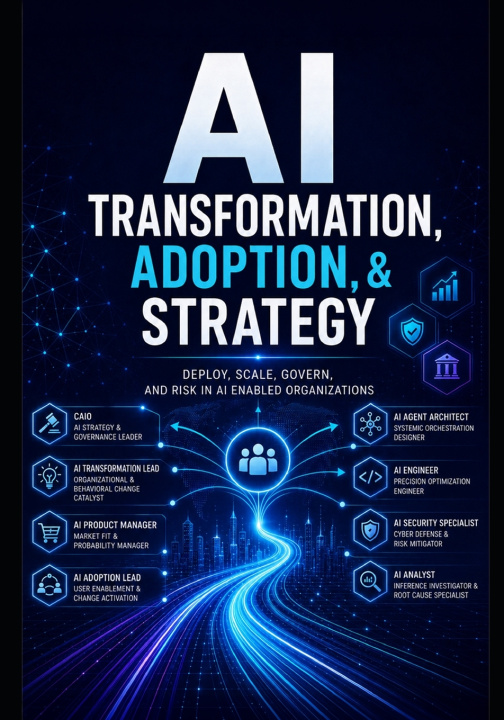
AI Transformation, Adoption, & Strategy
Deploy, Scale, Govern, and Risk in AI Enabled Organizations
 Angielski
 90 b
90 b
 Nowość
najlepszej
ceny ▸
Nawet do 30 dni na zwrot

AI is getting better faster than most enterprises are getting better at using it.
That is the uncomfortable starting point of AI Transformation. A stronger model can produce a sharper answer, but it cannot repair a broken approval chain, fragmented data, fuzzy decision rights, weak governance, confused ownership, or a workflow designed for a slower era. In fact, AI often makes those weaknesses more visible.
This book is a practical field guide for leaders who need to move beyond pilots, demos, and scattered productivity tools and build an enterprise that can deploy, govern, secure, operate, and scale AI as a real business capability.
Across 25 tightly connected chapters, Farrukh "Johnny" Malik shows how to redesign the management system around AI. You will learn how to identify where AI can genuinely change the business, redesign end-to-end workflows instead of automating isolated tasks, define human and machine decision rights, expose the true economics of intelligence, and make adoption part of the operating model rather than a training campaign.
The book then moves into the architecture now shaping AI Transformation: reliable enterprise context, model selection and routing, agentic workflows, Model Context Protocol, agent-to-agent interoperability, evaluations, autonomy tiers, runtime governance, zero-trust security, shadow AI discovery, and reusable controls for a changing regulatory environment.
It also tackles the questions that tend to arrive after the demo applause fades. Who is allowed to approve an AI action? What happens when an agent uses the wrong tool? How much human review can the workflow actually absorb? What does a successful transaction cost after evaluation, security, support, exceptions, and rework are included? Who owns the capability after the innovation team moves on? And what evidence should the board see before anyone declares that AI is "scaling"?
Most importantly, the discussion does not stop at launch. You will learn how to decide whether a pilot is actually production-ready, how to run AI and agents with production operations and AgentOps disciplines, how to monitor incidents and change, and how to measure adoption, quality, cost, risk, workflow performance, and realized business outcomes without confusing activity with value.
The book includes diagnostics, workflow maps, decision-rights matrices, scorecards, readiness gates, evaluation plans, governance models, threat maps, operating runbooks, and executive decision checklists designed for real leadership meetings. The tools are useful whether you are starting your first serious AI program or trying to bring order to a portfolio that has grown faster than its governance, architecture, or operating ownership.
AI Transformation is written for CAIOs, CIOs, CTOs, CFOs, COOs, CISOs, CDOs, transformation leaders, business-unit executives, architects, risk leaders, and board advisers who need a roadmap that survives contact with production.
There is also a little humor, because enterprise transformation has enough committees already.
The goal is simple: help you make better AI decisions, build systems that can survive the real enterprise, and create an operating model that can keep adapting as the technology changes.
Agentic AI governance: Agents, autonomy, controls, identity, and oversight
Chief artificial intelligence officer: Executive AI leadership and enterprise accountability
AI production operations: Production readiness, AgentOps, incidents, support, and resilience
AI risk management: Governance, security, controls, audit evidence, and regulation
Human AI collaboration: Workflow redesign, oversight, workforce change, and adoption
Model evaluation framework: Evaluations, acceptance thresholds, regression testing, and quality
Agent interoperability: MCP, A2A, tool integration, portability, and agent architecture


Informacje o książce
Angielski
