
 Kontakt
 Jak kupować

Dostawa
Doradca ds. zakupów
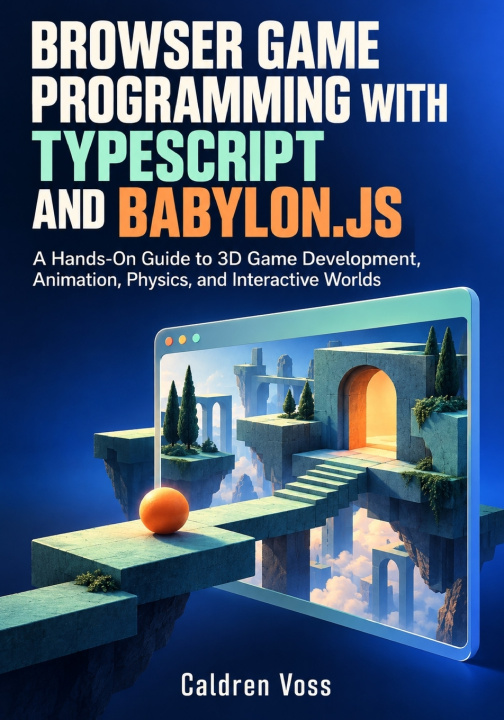
BROWSER GAME PROGRAMMING WITH TYPESCRIPT AND BABYLON.JS
A Hands-On Guide to 3D Game Development, Animation, Physics, and Interactive Worlds
 Angielski
 46 b
 Nowość
najlepszej
ceny ▸
Nawet do 30 dni na zwrot

A browser game is more than a three-dimensional scene. It needs responsive controls, dependable rules, meaningful feedback, and a release that works beyond the development machine.
A character may move at the wrong speed because time units are mixed. A collectible may award points twice. A model may load in the wrong coordinate frame, or a restart may leave active listeners behind. These are not merely visual problems: they expose gaps between the systems that make the game work.
This hands-on engineering guide shows how to build those systems deliberately. Through a structured sequence of typed implementation examples and controlled experiments, it takes you from a first rendered browser scene to a small, playable exploration game with objectives, hazards, and a tested deployment workflow.
- Establish a strict project setup and understand how the browser, rendering engine, scene, and game rules cooperate.
- Create geometry, apply transforms, configure cameras, and implement normalized movement that accounts for frame time.
- Handle keyboard, pointer, touch, and gamepad intentions, including object selection and interaction.
- Build readable environments with materials, lighting, imported assets, and event-driven animation.
- Use collision queries, trigger regions, and physical simulation appropriately and investigate timing or contact problems.
- Keep scoring, collectible objectives, hazards, victory, defeat, and restart behavior consistent through explicit game states.
- Connect interface and audio feedback to measurable performance, cleanup, compatibility, and release checks.
Designed for learners and developers with basic scripting, web markup, and development-tool experience, this is a practical next step into interactive three-dimensional programming. Essential vectors, transformations, and mechanics are introduced as needed; advanced mathematics is not assumed.
Start with the first scene and follow the path to a more understandable, testable, and maintainable browser game.


Informacje o książce
Angielski

Podaruj tę książkę jeszcze dziś
To łatwe
1 Dodaj książkę do koszyka i wybierz „dostarczyć jako prezent” 2 W odpowiedzi wyślemy Ci bon 3 Książka dotrze na adres obdarowanegoCześć! Jestem Libroamiko, Twój doradca książkowy.
Jak mogę Ci pomóc?