
 Kontakt
 Jak kupować
Dostawa
Doradca ds. zakupów
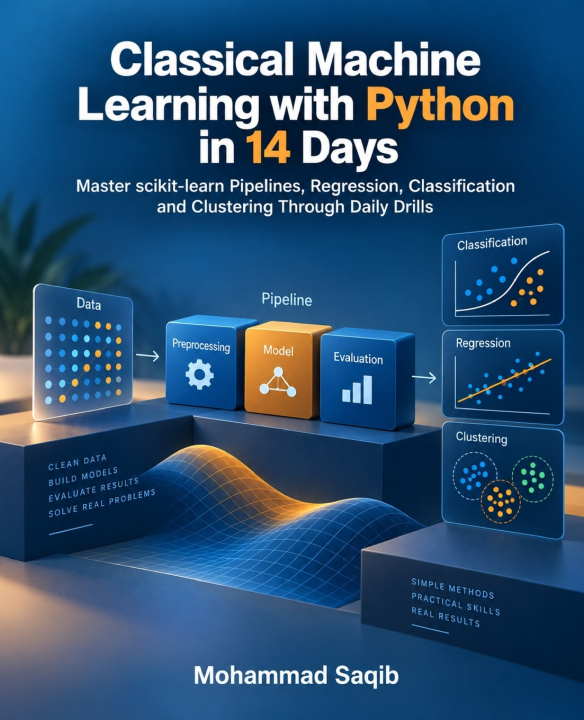
Classical Machine Learning with Python in 14 Days
Master scikit-learn Pipelines, Regression, Classification and Clustering Through Daily Drills
 Angielski
 63 b
63 b
 Zapowiedź
 Nowość
Nawet do 30 dni na zwrot

Fourteen days of drills that turn classical machine learning into something you can defend to somebody who asks how you know.
This is a book of problems, built around one question: what does a program learn from a table of numbers, and how much of that learning is real. Every rule is stated in as few words as it can be, shown working in a short Python program with its real captured output, then handed back as drills. Nothing is asserted that is not also demonstrated. Every listing was executed on scikit-learn 1.9 with no network access, and every printed result is what that run returned.
Week 1 - from a table to a measured model
Day 1 - The Shape of a Learning Problem
Day 2 - Data In, Problems Out
Day 3 - Fitting a Number
Day 4 - When the Fit Is Too Free
Day 5 - Fitting a Class
Day 6 - The Pipeline
Day 7 - Measuring Without Lying
Week 2 - from a model to one you can ship
Day 8 - Searching for Settings
Day 9 - Questions in Sequence
Day 10 - Fitting What Is Left Over
Day 11 - Distance, Counts and Margin
Day 12 - Judging a Classifier
Day 13 - Learning Without Labels
Day 14 - A Model That Leaves the Laptop
The programming problems build one toolkit across the fourteen days. It is called mlkit, and it grows a piece a day: a loader that says whether a task is a class question or a number question, splits that keep proportions and keep groups together, preprocessors for gaps and text columns, reports that print the counts a rate was computed from, a search that says what it will cost before it runs, and finally a saved model with the card of facts needed to trust it six months later.
Along the way: the estimator contract of fit, predict and transform; ridge, lasso and the coefficient path a penalty draws; the decision threshold that turns a probability into a class; the column transformer that makes leakage impossible rather than unlikely; why the score you searched on is optimistic; permutation importance; early stopping; the maximum margin; ROC and precision-recall curves; calibrated probabilities; k-means, DBSCAN and principal components.
The book reports what it measured, including the times the measurement contradicted the plan: a scaler leak worth nothing, a halving search slower than the grid it replaced, and a reduction that bought one row and cost more time than it saved.
322 worked examples, each with a complete runnable program, its captured output and a figure. 322 figures. 1,288 problems across five sets that close every chapter in the same order, ending in practice problems with no answers anywhere in the book. That last part is deliberate.
For developers who can write Python, have no calculus, and want to know which parts of a model's score they are allowed to believe.


Informacje o książce
Angielski

Podaruj tę książkę jeszcze dziś
To łatwe
1 Dodaj książkę do koszyka i wybierz „dostarczyć jako prezent” 2 W odpowiedzi wyślemy Ci bon 3 Książka dotrze na adres obdarowanegoCześć! Jestem Libroamiko, Twój doradca książkowy.
Jak mogę Ci pomóc?