Kontakt
 Jak kupować
Dostawa
Doradca ds. zakupów
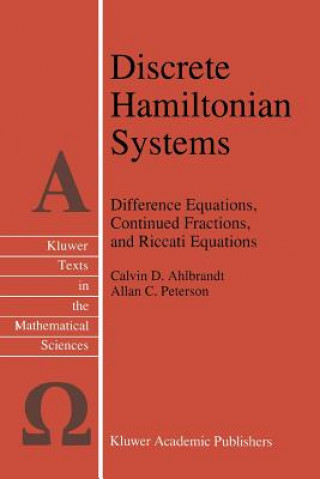
Discrete Hamiltonian Systems
Difference Equations, Continued Fractions, and Riccati Equations
 Angielski
 746 b
746 b
Nawet do 30 dni na zwrot
Klienci kupili także




 /
/
 Miękka
 274.32
zł
274.32
zł
















 /
Miękka
48.69
zł
/
Miękka
48.69
zł


 /
Miękka
107.33
zł
/
Miękka
107.33
zł

 /
Miękka
74.76
zł
/
Miękka
74.76
zł



This book should be accessible to students who have had a first course in matrix theory. The existence and uniqueness theorem of Chapter 4 requires the implicit function theorem, but we give a self-contained constructive proof ofthat theorem. The reader willing to accept the implicit function theorem can read the book without an advanced calculus background. Chapter 8 uses the Moore-Penrose pseudo-inverse, but is accessible to students who have facility with matrices. Exercises are placed at those points in the text where they are relevant. For U. S. universities, we intend for the book to be used at the senior undergraduate level or beginning graduate level. Chapter 2, which is on continued fractions, is not essential to the material of the remaining chapters, but is intimately related to the remaining material. Continued fractions provide closed form representations of the extreme solutions of some discrete matrix Riccati equations. Continued fractions solution methods for Riccati difference equations provide an approach analogous to series solution methods for linear differential equations. The book develops several topics which have not been available at this level. In particular, the material of the chapters on continued fractions (Chapter 2), symplectic systems (Chapter 3), and discrete variational theory (Chapter 4) summarize recent literature. Similarly, the material on transforming Riccati equations presented in Chapter 3 gives a self-contained unification of various forms of Riccati equations. Motivation for our approach to difference equations came from the work of Harris, Vaughan, Hartman, Reid, Patula, Hooker, Erbe & Van, and Bohner.


Informacje o książce
Angielski

Podaruj tę książkę jeszcze dziś
To łatwe
1 Dodaj książkę do koszyka i wybierz „dostarczyć jako prezent” 2 W odpowiedzi wyślemy Ci bon 3 Książka dotrze na adres obdarowanegoMogłoby Cię także zainteresować




















 /
Twarda
143.75
zł
/
Twarda
143.75
zł