
 Kontakt
 Jak kupować

Dostawa
Doradca ds. zakupów
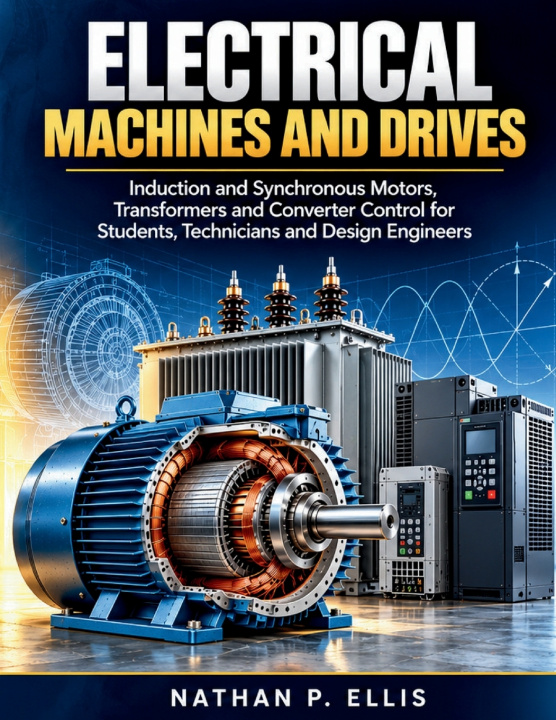
Electrical Machines and Drives
Induction and Synchronous Motors, Transformers and Converter Control for Students, Technicians and Design Engineers
 Angielski
 165 b
 Zapowiedź
 Nowość
Nawet do 30 dni na zwrot

The induction motor on the plant floor, the transformer that feeds it and the variable frequency drive that controls it all obey the same small set of electromagnetic relationships. Most books teach only one of those pieces at a time, and leave the reader to assemble the rest alone.
A student finishes a first course able to draw an equivalent circuit but unsure how it relates to the drive parameters on a real nameplate. A technician can commission a drive from the manual but has no clear model of why a motor pulls excessive current at low frequency without voltage boost, or why a long motor cable damages insulation. A design engineer selecting and sizing equipment finds the theory in one reference, the converter in a second and the protection coordination in a third, with notation that changes from book to book. The gap is not a lack of information. It is the absence of a single, consistently written account that runs from magnetic circuits to field-oriented control without a break.
This book closes that gap. Across sixteen self-contained chapters it develops electromechanical energy conversion from first principles, carries it through transformers, direct current machines, three-phase induction machines, synchronous machines and permanent-magnet and special machines, and then applies it directly to the power electronic converters and control strategies inside a modern drive. Every equation carries its variables and units, every symbol means the same thing in every chapter, and worked examples show complete numerical calculations with an engineering interpretation of the result.
What this book helps you do- Trace torque, speed, voltage and current from a stated assumption to a boxed numerical answer, so that results can be checked rather than taken on trust.
- Extract equivalent-circuit parameters from open-circuit, short-circuit, no-load, blocked-rotor and direct-current tests, and use them to predict performance.
- Compare starting methods for induction motors, from across-the-line and wye-delta starting to autotransformer, rotor-resistance and solid-state soft starting.
- Understand why scalar volts-per-hertz control reaches its limits and how the Clarke and Park transformations lead to direct and indirect field-oriented control and direct torque control.
- Recognise the drive-related effects that cause field problems, including reflected-wave overvoltage, common-mode bearing current, harmonic distortion and direct-current bus faults.
- Match a machine and drive type to a load, coordinate overload and short-circuit protection and plan commissioning and maintenance.
Magnetic circuits and core materials, transformer equivalent circuits, testing, connections and parallel operation, direct current machine construction, speed control and braking, three-phase induction machine theory, testing, torque-speed characteristics and speed control, single-phase motors, synchronous machine steady-state theory, synchronising and excitation, permanent-magnet synchronous and brushless direct current motors, stepper, switched-reluctance and synchronous reluctance machines, rectifiers, inverters and pulse-width modulation, variable frequency drives, drive system integration and protection, efficiency classes, condition monitoring and maintenance strategy.
Who it is forStudents in a first course on electric machines and drives, technicians who install, test and troubleshoot motors, transformers and drives, and design engineers who select, size and integrate them into larger systems. Each chapter can be read on its own, so the book serves equally as a sequential text and as a standing reference.
Open this book and start building the connected understanding of machines, converters and control that a single course or a single manual never quite delivers.


Informacje o książce
Angielski
Kategoria

Podaruj tę książkę jeszcze dziś
To łatwe
1 Dodaj książkę do koszyka i wybierz „dostarczyć jako prezent” 2 W odpowiedzi wyślemy Ci bon 3 Książka dotrze na adres obdarowanegoCześć! Jestem Libroamiko, Twój doradca książkowy.
Jak mogę Ci pomóc?