
 Kontakt
 Jak kupować

Dostawa
Doradca ds. zakupów
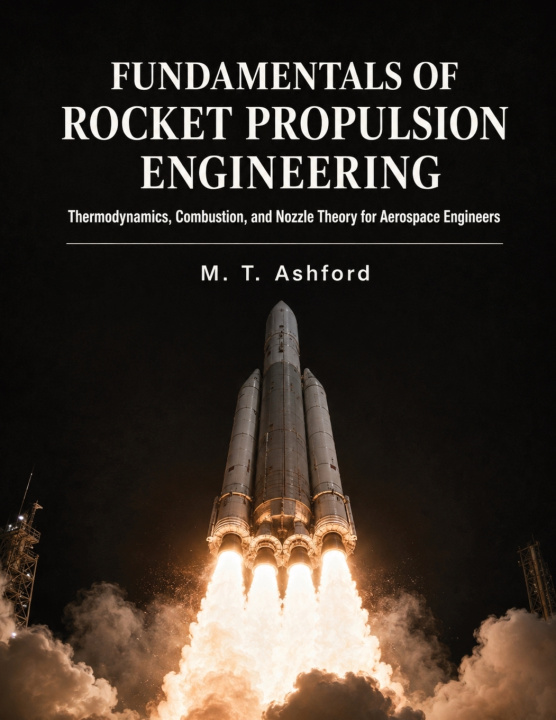
Fundamentals of Rocket Propulsion Engineering
Thermodynamics, Combustion, and Nozzle Theory for Aerospace Engineers
 Angielski
 143 b
 TOP
 Nowość
Nawet do 30 dni na zwrot
Klienci kupili także


Every rocket engine comes down to the same underlying question: how much of the propellant's stored energy actually turns into useful thrust - and answering it well means moving fluently between thermodynamics, compressible fluid mechanics, chemical kinetics, heat transfer, structural mechanics, and controls, subjects that are normally taught in separate courses.
Many students and early-career engineers can plug numbers into a specific-impulse formula or a rocket-equation calculator without ever seeing where that formula comes from, what assumption makes it valid, or what it costs in accuracy when that assumption is stretched. Readers who have only seen these subjects in isolation often struggle to connect them: to see how a chamber-pressure decision cascades into feed-system mass, turbopump requirements, injector pressure drop, and cooling-channel sizing all at once. That gap becomes a real liability the moment a design departs from an idealized textbook case.
This engineering textbook builds rocket propulsion from first principles, chapter by chapter, deriving every major performance relation rather than simply presenting it - so the reader can see exactly where each assumption enters a derivation, practise applying it to realistic sizing and trade-off problems, and develop the judgment to know when a simplified model is trustworthy and when it is not.
Key Benefits
- Derive the rocket thrust equation from a momentum balance and connect chamber conditions to nozzle exit velocity through the isentropic flow relations.
- Practise sizing nozzles, solid motor grains, liquid feed systems, injectors, combustion chambers, and turbopumps using the same worked-example format throughout the book, with units tracked and results sanity-checked.
- Apply the specific-impulse relation and the rocket equation to multi-stage vehicle sizing, staging optimization, and mission delta-v budgeting.
- Evaluate propellant combinations and combustion thermochemistry trade-offs, including performance, density, storability, and handling-hazard considerations.
- Apply regenerative, radiative, ablative, and film-cooling design relations to a combustion chamber and nozzle thermal problem.
- Interpret static test data, apply measurement-uncertainty analysis, and connect measured performance back to earlier analytical predictions.
- Approach propulsion system safety, reliability, and failure analysis with the same quantitative habits used for performance calculations.
Key Topics Covered
Sixteen chapters move from thermodynamic and gas-dynamic foundations through nozzle theory, rocket performance parameters and staging, propellant chemistry and combustion thermochemistry, solid rocket motors, liquid engine feed systems, combustion chamber and injector design, turbopumps and turbomachinery, cooling system design, hybrid rocket propulsion, materials and structural analysis, electric and advanced propulsion concepts, engine testing and instrumentation, propulsion system safety and reliability, and vehicle-level staging optimization and mission design - all built on a locked, consistent symbol table and supported by appendices, a glossary, and an index for ongoing reference use.
Written for engineering students who have completed introductory coursework in thermodynamics, fluid mechanics, and calculus, and for early-career or transitioning engineers who need one coherent, derivation-first reference spanning the full propulsion stack rather than a narrow subsystem treatment. No prior propulsion-specific coursework is assumed.
Get a copy and start building a clearer, first-principles understanding of the subject - a single, coherent propulsion reference designed to stay within reach from first derivation to final vehicle design.


Informacje o książce
Angielski

Podaruj tę książkę jeszcze dziś
To łatwe
1 Dodaj książkę do koszyka i wybierz „dostarczyć jako prezent” 2 W odpowiedzi wyślemy Ci bon 3 Książka dotrze na adres obdarowanegoMogłoby Cię także zainteresować







Cześć! Jestem Libroamiko, Twój doradca książkowy.
Jak mogę Ci pomóc?