
 Kontakt
 Jak kupować
Dostawa
Doradca ds. zakupów
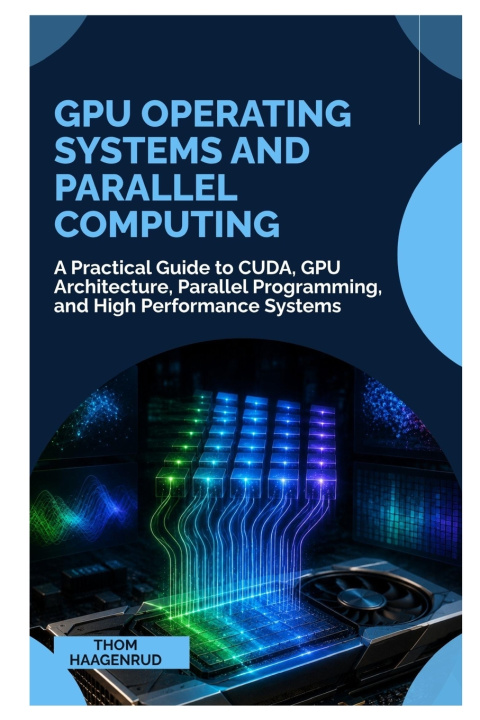
GPU Operating Systems and Parallel Computing
A Practical Guide to CUDA, GPU Architecture, Parallel Programming, and High Performance Systems
 Angielski
 45 b
45 b
 Nowość
najlepszej
ceny ▸
Nawet do 30 dni na zwrot

Stop Treating the GPU Like a Faster CPU. Learn to Engineer It as a Complete Computing System.
Modern GPU development is no longer just about writing a CUDA kernel and hoping it runs faster. Real performance depends on the entire path from application code to driver, memory system, scheduler, hardware, and production infrastructure.
GPU Operating Systems and Parallel Computing gives you a practical, systems-level framework for understanding that entire stack.
Starting with the GPU operating environment, this guide explains how host operating systems, drivers, runtimes, contexts, queues, memory mappings, firmware, and hardware schedulers work together. From there, it moves into GPU architecture, parallel decomposition, CUDA programming, memory optimization, asynchronous execution, profiling, debugging, multi-GPU computing, and production deployment.
Inside, you'll learn how to:
Understand the GPU software and hardware stack-and diagnose problems at the correct layer
Think in terms of warps, blocks, grids, streaming multiprocessors, memory hierarchies, and resource limits
Design parallel algorithms around independence, dependencies, locality, load balance, and scaling
Build and troubleshoot a CUDA development environment
Write correct CUDA kernels and reason about execution, synchronization, and launch configuration
Optimize memory access, data reuse, transfers, and shared-memory usage
Use streams, events, CUDA Graphs, and concurrency to build efficient pipelines
Profile workloads systematically instead of relying on optimization folklore
Debug memory errors, race conditions, synchronization failures, and numerical problems
Design multi-GPU workloads using topology awareness, collectives, MPS, and MIG
Build reliable GPU applications with observability, testing, reproducibility, security, and deployment practices
Evaluate CUDA, HIP, SYCL, and abstraction layers when portability matters
The book is designed for developers and engineers working in GPU programming, HPC, machine learning, scientific computing, simulation, rendering, backend infrastructure, and high-performance systems. It combines conceptual explanations with diagrams, tables, code examples, exercises, and practical engineering decision processes.
Most importantly, it teaches a repeatable approach to GPU performance: establish correctness, measure the complete workload, identify the real bottleneck, make a targeted change, and validate the result.
Whether you're learning CUDA, optimizing an existing GPU workload, building a multi-GPU service, or designing production accelerator infrastructure, this book helps you connect parallel programming concepts to the physical realities of modern GPU systems.
Build faster GPU software-but more importantly, learn why it is fast, when it will fail, and how to make it dependable.


Informacje o książce
Angielski

Podaruj tę książkę jeszcze dziś
To łatwe
1 Dodaj książkę do koszyka i wybierz „dostarczyć jako prezent” 2 W odpowiedzi wyślemy Ci bon 3 Książka dotrze na adres obdarowanegoCześć! Jestem Libroamiko, Twój doradca książkowy.
Jak mogę Ci pomóc?