
 Kontakt
 Jak kupować
Dostawa
Doradca ds. zakupów
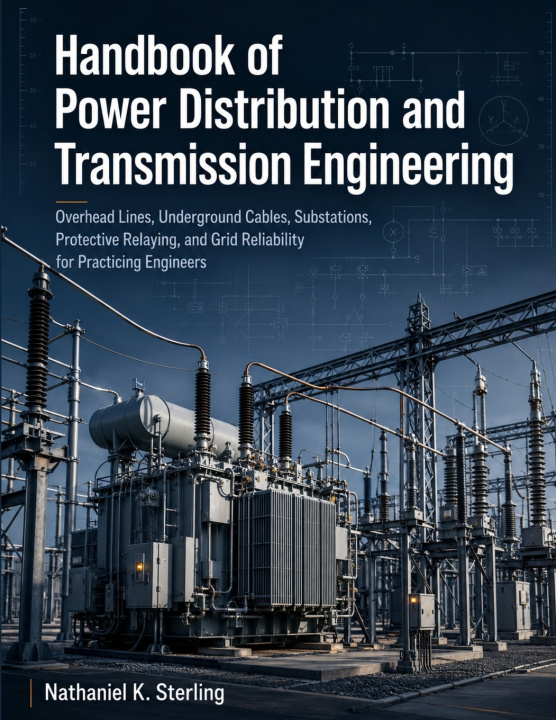
Handbook of Power Distribution and Transmission Engineering
Overhead Lines, Underground Cables, Substations, Protective Relaying, and Grid Reliability for Practicing Engineers
 Angielski
 253 b
253 b
 Nowość
najlepszej
ceny ▸
Nawet do 30 dni na zwrot

The transmission and distribution network carries every kilowatt-hour to the point where it is actually used, and it is the part of the power system that formal training covers least completely.
Engineers in this field are served by two kinds of book, and neither is sufficient alone. The academic text derives line equations and load flow with rigour but says almost nothing about conductor selection, sag and tension, ground grid design, cable current rating, or relay coordination. The utility manual supplies procedure in abundance but presents its results as rules to be followed rather than as consequences to be understood. An engineer holding only the first cannot design a feeder. An engineer holding only the second cannot recognise the moment when the rule stops applying, which is exactly the moment when judgement is required.
This handbook closes that gap across sixteen chapters, developed in one consistent notation and carried through to the level of a working calculation. Derivations are shown in full, assumptions are stated where they are used, and units are tracked throughout. Concepts are developed once, in the chapter that owns them, so each chapter can be consulted on its own.
What you will be able to do:
- Build the analytical vocabulary the field depends on, including three-phase representation, per-unit modelling, symmetrical components, and sequence networks, developed from first principles.
- Carry an overhead conductor from thermal rating through ice and wind loading, catenary behaviour, change of state, ruling span, creep, clearance, insulator swing, and right-of-way width.
- Rate underground circuits properly, treating the thermal circuit, soil resistivity and dry-out, mutual heating, cyclic and emergency ratings, charging current, and sheath bonding.
- Design a ground grid to a defensible standard, from soil resistivity and tolerable body current through grid resistance, ground potential rise, mesh and step voltages, and transferred potential.
- Plan a feeder and hold its voltage: load forecasting, load reach, voltage drop, losses, economic conductor selection, capacitors, regulators, and power quality.
- Calculate faults and coordinate protection across all four fault types, system grounding, time-current characteristics, distance and pilot schemes, and differential protection.
- Evaluate reliability and change, using standard indices, predictive feeder analysis, asset management, hosting capacity, interconnection, and energy storage.
It is written for practising transmission and distribution engineers, utility planning and protection staff, consulting engineers, technologists entering power system work, and senior undergraduate and graduate students. It assumes introductory circuit analysis and comfort with phasors, but no prior exposure to power systems. The treatment is oriented to Canadian practice, where ice loading is a design case and requirements vary between provinces, while the analytical content remains fully transferable elsewhere.
Open this handbook and start building the kind of understanding that lets you not only perform the calculation, but defend the result.


Informacje o książce
Angielski

Podaruj tę książkę jeszcze dziś
To łatwe
1 Dodaj książkę do koszyka i wybierz „dostarczyć jako prezent” 2 W odpowiedzi wyślemy Ci bon 3 Książka dotrze na adres obdarowanegoCześć! Jestem Libroamiko, Twój doradca książkowy.
Jak mogę Ci pomóc?