
 Kontakt
 Jak kupować
Dostawa
Doradca ds. zakupów
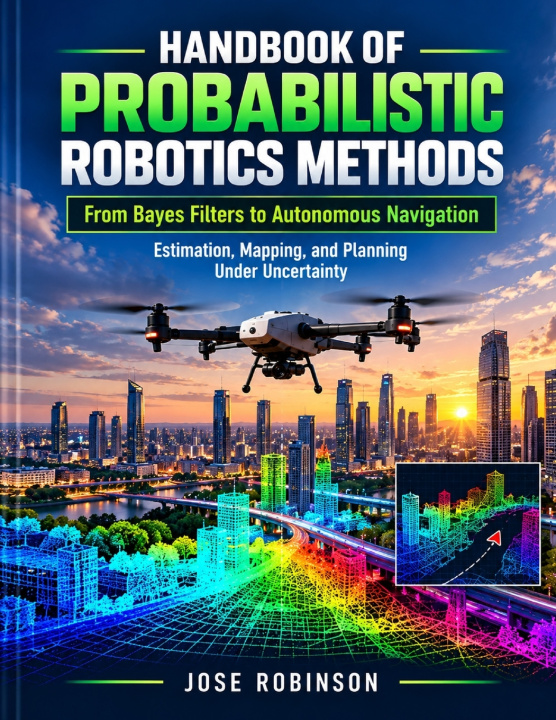
Handbook Of Probabilistic Robotics Methods
From Bayes Filters to Autonomous Navigation: Estimation, Mapping, and Planning Under Uncertainty
 Angielski
 191 b
191 b
 Nowość
najlepszej
ceny ▸
Nawet do 30 dni na zwrot

How does an autonomous robot make reliable decisions when its sensors are noisy, its movements are imperfect, and the world around it is constantly changing?
That challenge lies at the heart of probabilistic robotics.
Real-world robots rarely know their exact position, the precise state of their surroundings, or the outcome of every action. Wheels slip. Sensors produce noisy measurements. Environments change. Maps become imperfect. Autonomous systems therefore need more than a single best estimate-they need principled methods to represent uncertainty, update beliefs, and make informed decisions from imperfect information.
Probabilistic Robotics provides a structured, mathematically grounded path from probability and recursive Bayesian estimation to robot localization, mapping, SLAM, sensor fusion, planning, exploration, and autonomous navigation.
Rather than presenting algorithms as isolated formulas, this handbook explains the assumptions behind them, develops the mathematics step by step, works through numerical examples, and connects theory with practical implementation issues such as numerical stability, computational cost, filter tuning, and statistical consistency.
Inside, you will explore how to:
- Build a strong foundation in Bayesian state estimation, prediction, measurement updates, and belief representation.
- Understand and apply Kalman, extended Kalman, unscented Kalman, information, histogram, and particle filters.
- Model uncertain robot motion and sensor measurements for real-world autonomous systems.
- Approach mobile robot localization using probabilistic methods for estimating and maintaining position.
- Build occupancy grid maps and tackle simultaneous localization and mapping (SLAM) through filtering, graph-based smoothing, and particle-based methods.
- Explore planning and decision-making under uncertainty, including partially observable problems and information-gathering actions.
- Connect mathematical theory with implementation through worked examples, algorithms, practice problems, filter tuning, consistency testing, and multi-sensor case studies.
The material progresses systematically from probability and Bayes filters through Gaussian and nonparametric filtering, motion and measurement models, localization and mapping, SLAM, decision-making, autonomous exploration, and integrated multi-sensor applications.
Designed for graduate students, robotics researchers, practicing engineers, and developers working with mobile robots, autonomous vehicles, aerial systems, and field robotics, the book assumes familiarity with linear algebra, multivariable calculus, elementary probability, and scientific programming while developing the robotics background needed for the methods covered.
Move beyond treating uncertainty as an inconvenience. Learn to model it, estimate through it, and use it systematically to understand how autonomous robots localize, map, plan, and navigate in an uncertain world.


Informacje o książce
Angielski

Podaruj tę książkę jeszcze dziś
To łatwe
1 Dodaj książkę do koszyka i wybierz „dostarczyć jako prezent” 2 W odpowiedzi wyślemy Ci bon 3 Książka dotrze na adres obdarowanegoCześć! Jestem Libroamiko, Twój doradca książkowy.
Jak mogę Ci pomóc?