
 Kontakt
 Jak kupować
Dostawa
Doradca ds. zakupów
 Angielski
 83 b
83 b
 Zapowiedź
 Nowość
Nawet do 30 dni na zwrot

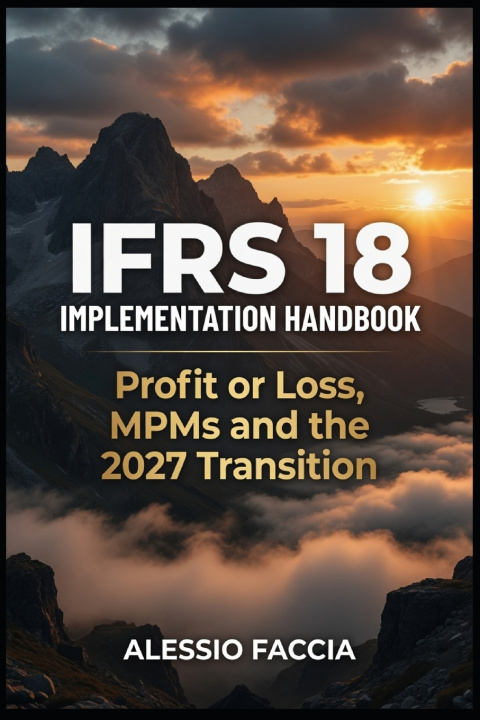
IFRS 18 will transform how organisations present profit or loss, define operating performance, disclose management measures and rebuild comparative financial information for 2027.
IFRS 18 applies to annual reporting periods beginning on or after 1 January 2027. The Standard replaces IAS 1 and introduces a structured statement of profit or loss with operating, investing, financing, income tax and discontinued operation categories. It also establishes mandatory subtotals, including operating profit and profit before financing and income taxes, and brings management-defined performance measures into the financial statements.
IFRS 18 Implementation Handbook gives finance professionals a practical route from technical interpretation to operational readiness.
Where should interest income, foreign exchange differences, derivatives, investment returns and financing costs appear? Which entities qualify as having specified main business activities? Which adjusted measures qualify as MPMs? How should management reconcile those measures and calculate tax and non-controlling interest effects? How should groups rebuild comparative figures and prepare their first IAS 34 interim reports under IFRS 18?
The handbook answers these questions through detailed analysis, implementation methods and applied examples.
Readers will learn how to:
• classify income and expenses across the five IFRS 18 categories
• calculate mandatory subtotals and assess additional subtotals
• identify MPMs in earnings releases, investor presentations and other public communications
• prepare MPM reconciliations, tax effects and non-controlling interest allocations
• select presentation by nature, function or a mixed method
• disclose specified expenses by nature
• redesign charts of accounts and transaction tags
• build group consolidation mappings and elimination rules
• align KPIs, board packs and investor communications
• reconstruct annual and interim comparative information
• prepare IFRS 18 transition reconciliations
• conduct impact assessments, data remediation, parallel runs and acceptance testing
• strengthen disclosure controls and audit evidence
• implement digital reporting through the IFRS Accounting Taxonomy
• establish transition governance and post-implementation monitoring
Chapter 1 explains the new structure of the statement of profit or loss, including classification, foreign exchange differences, derivatives, specified main business activities and mandatory line items.
Chapter 2 provides a rigorous framework for management-defined performance measures, covering qualification tests, public communications, excluded measures, reconciliations, tax, non-controlling interests and governance.
Chapter 3 converts IFRS 18 into reporting architecture through account tagging, consolidation mappings, KPI alignment, reporting packs, internal controls and digital reporting.
Chapter 4 prepares organisations for retrospective application, comparative reconstruction, IAS 34 interim reporting, testing, approval, auditor review, investor communication and continuing monitoring.
Finance directors, financial controllers, accountants, auditors, consultants, tax and treasury professionals, investor relations officers and audit committee members will find a structured implementation resource that reflects practical reporting realities.
IFRS 18 compliance requires a redesigned income statement, controlled data, consistent definitions, traceable judgements and coordinated governance. The handbook provides the framework needed to protect comparability, communicate performance clearly and establish an audit-ready reporting process for 2027 and beyond.


Informacje o książce
Angielski

Podaruj tę książkę jeszcze dziś
To łatwe
1 Dodaj książkę do koszyka i wybierz „dostarczyć jako prezent” 2 W odpowiedzi wyślemy Ci bon 3 Książka dotrze na adres obdarowanegoCześć! Jestem Libroamiko, Twój doradca książkowy.
Jak mogę Ci pomóc?