
 Kontakt
 Jak kupować
Dostawa
Doradca ds. zakupów
 Angielski
 43 b
43 b
 Zapowiedź
 Nowość
Nawet do 30 dni na zwrot

What does it take to build an empire around a sacred vision?
Long before Angkor Wat became one of the world's most recognizable monuments, the Khmer Empire emerged from a landscape shaped by monsoon rains, the Mekong River, and the extraordinary seasonal cycle of the Tonle Sap. From this environment grew a civilization capable of organizing vast networks of agriculture, labor, religion, engineering, and royal power.
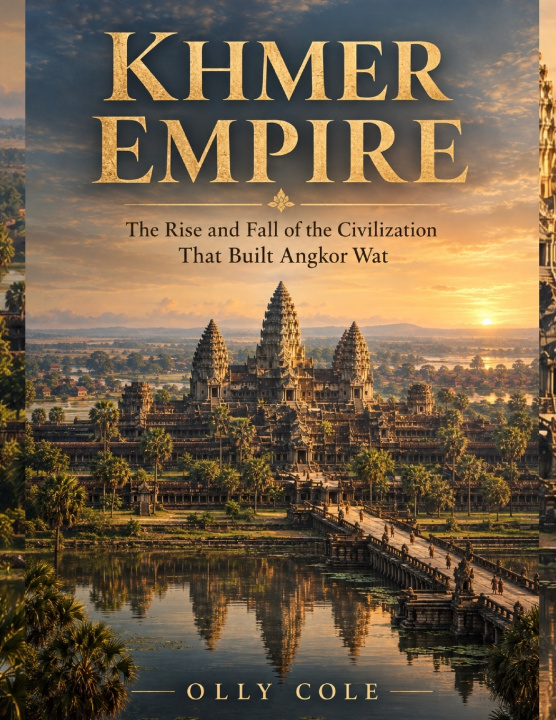
Khmer Empire: The Rise and Fall of the Civilization That Built Angkor Wat explores the remarkable history behind the monuments, looking beyond the familiar towers of Angkor Wat to the people, rulers, beliefs, and systems that made them possible.
Beginning with the communities that inhabited the region before Angkor, this book traces the emergence of Khmer political power and the rise of Jayavarman II, whose association with the Devaraja tradition helped establish a new model of sacred kingship. It examines how later rulers transformed that political foundation into a powerful state through rice cultivation, labor systems, temple estates, canals, reservoirs, and monumental architecture.
At the heart of the story stands Angkor Wat and the reign of Suryavarman II. Readers will discover why the temple was dedicated primarily to Vishnu, how enormous quantities of sandstone were quarried and transported, how generations of workers contributed to its construction, and how its galleries transformed religious mythology, warfare, and royal authority into images carved in stone.
The story then moves through one of the empire's greatest periods of crisis and renewal. Following the Cham sack of Angkor in 1177, Jayavarman VII rebuilt Khmer power and created Angkor Thom, with the extraordinary Bayon at its center. His reign also reveals a different vision of kingship, one expressed through Buddhist devotion, roads, rest houses, hospitals, and an expansive program of public works.
But the Khmer Empire did not simply rise, reach its height, and suddenly disappear.
The later chapters examine the transformation of Khmer religious life, the rise of Theravada Buddhism, growing pressure from neighboring powers, and the gradual strain placed on the systems that had sustained Angkor for centuries. The famous siege of 1431 is considered within this wider process rather than treated as a single moment that instantly ended Khmer civilization.
The story continues beyond the political decline of Angkor, following the movement of Khmer power toward Longvek, Oudong, and Phnom Penh. It also examines the enduring life of Angkor itself and challenges the familiar idea that the great temples were simply "lost" until Europeans rediscovered them centuries later. Angkor remained part of Khmer religious and cultural life even as the political center moved elsewhere.
This is a history of temples, kings, wars, and empires, but also of farmers, fishers, laborers, priests, craftsmen, and administrators whose lives made the achievements of Angkor possible.
For readers interested in Khmer history, the Khmer Empire, Angkor Wat, ancient and medieval Southeast Asia, Cambodian history, Jayavarman II, Suryavarman II, Jayavarman VII, and the rise and transformation of Angkor, this book offers a historical journey through one of Southeast Asia's most extraordinary civilizations.
The stones of Angkor remain. The story behind them is even larger.
Step into the world that built them.


Informacje o książce
Angielski
Kategoria

Podaruj tę książkę jeszcze dziś
To łatwe
1 Dodaj książkę do koszyka i wybierz „dostarczyć jako prezent” 2 W odpowiedzi wyślemy Ci bon 3 Książka dotrze na adres obdarowanegoCześć! Jestem Libroamiko, Twój doradca książkowy.
Jak mogę Ci pomóc?