
 Kontakt
 Jak kupować
Dostawa
Doradca ds. zakupów
Maya Dynamics
The Complete FX & Simulation Field Guide
 Angielski
 93 b
93 b
 Nowość
najlepszej
ceny ▸
Nawet do 30 dni na zwrot

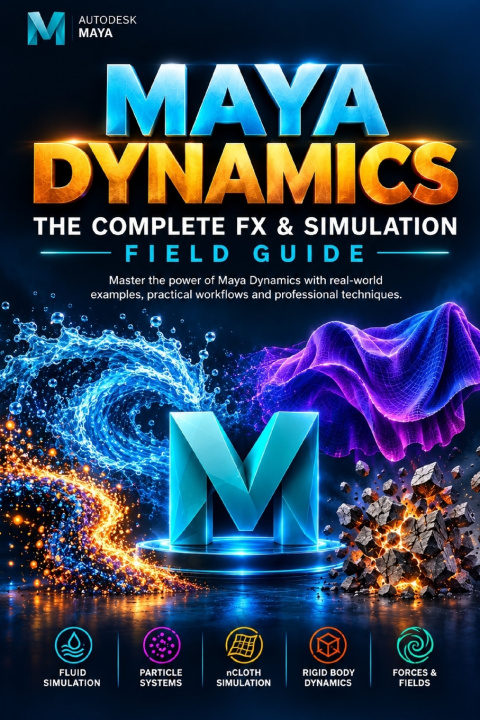
Maya Dynamics - The Complete FX & Simulation Field Guide
In traditional 3D computer animation, keyframing allows artists to manipulate object transforms with exacting control, acting as a puppeteer. However, keyframing encounters severe efficiency bottlenecks when animating non-rigid, amorphous natural phenomena like smoke, fire, water, and clouds. Maya Dynamics: The Complete FX & Simulation Field Guide part 01 addresses these limitations by replacing manual keyframing with physically based, procedural simulation. Authored by veteran animation and visual effects (VFX) expert Sourabh Shrivastava-drawing from over 20 years of multidisciplinary industry experience across feature film visual effects, high-budget blockbusters, and university technical education-this field guide bridges foundational physics theory with production-grade visual effects execution.
The book systematically explores Autodesk Maya's underlying node-based architecture, detailing how the Dependency Graph (DG) and Directed Acyclic Graph (DAG) process scalar and per-particle (PP) array attributes through interconnected data pipelines. Readers are introduced to atomic dynamic units, including particle systems managing points in global space, positional and geometry emitters regulating creation rates and momentum inheritance, and external force fields such as gravity, turbulence, and aerodynamic drag. To ensure physical realism across diverse production pipelines, the guide details crucial space scale calibrations and unit interpretations on solver nodes.
Expanding beyond basic particles, the text covers deformable soft bodies governed by Hooke's Law springs and shape-memory goals, as well as solid rigid bodies controlled by active/passive states and mechanical constraint linkages. To achieve complete art-directable control over simulations, the field guide demonstrates advanced MEL (Maya Embedded Language) scripting and expressions. It highlights the distinct roles of single-value Attribute Expressions versus massively parallel Particle Expressions executed per particle, differentiating one-time Creation Rules from frame-by-frame Runtime Rules driven by 3D vector math and conditional logic.
Finally, the book unveils the modern Maya Nucleus unified simulation framework, empowering FX artists and technical directors to orchestrate multi-object interactions between nCloth, nParticle, nHair, and nRigid colliders within a single, iterative solver universe. It details crucial solver settings such as substep time stepping, max collision iterations, and collision interleaving to maintain simulation stability. Furthermore, the guide covers deterministic nCache disk-baking workflows (XML headers and IFF binary arrays), collision pruning, and velocity array retention for simulation resumes. Designed to equip artists beyond default solver settings, this book provides the mental models, scripting frameworks, and optimization methodologies required to master procedural physics in modern visual effects pipelines.


Informacje o książce
Angielski

Podaruj tę książkę jeszcze dziś
To łatwe
1 Dodaj książkę do koszyka i wybierz „dostarczyć jako prezent” 2 W odpowiedzi wyślemy Ci bon 3 Książka dotrze na adres obdarowanegoCześć! Jestem Libroamiko, Twój doradca książkowy.
Jak mogę Ci pomóc?