
 Kontakt
 Jak kupować
Dostawa
Doradca ds. zakupów
 Angielski
 54 b
54 b
 Nowość
Nawet do 30 dni na zwrot

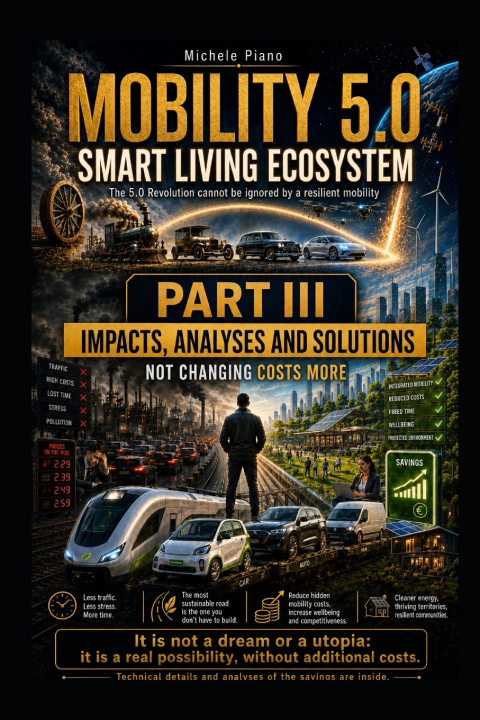
Mobility 5.0 - Smart Living Ecosystem, Part III examines the social, environmental, economic and geopolitical consequences of moving from vehicle-centred mobility to an integrated system designed around human needs, territorial resilience and the intelligent use of existing resources.
Rather than evaluating innovation solely through vehicle performance, electrification or infrastructure expansion, the book introduces a broader criterion: the systemic cost of fulfilling a human need. Energy consumption, land use, maintenance, congestion, accidents, compulsory travel, lost time and technological dependence are therefore assessed together. Progress is measured not only by kilometres travelled or speed achieved, but by the time, autonomy, safety and opportunities returned to people.
The first analysis explores human resilience, transport poverty, proximity services, healthcare, education, sport and the social value of useful time. The second examines territorial metabolism, intermodality, avoided infrastructure, distributed energy, local economic value and Digital Twin simulations. The third addresses industrial and geopolitical sovereignty, focusing on critical raw materials, sodium-ion batteries, rare-earth-free motors, recycling, open standards, regional supply chains and the reduction of technological lock-in.
Mobility 5.0 does not propose travelling less, rejecting technology or stopping development. It proposes organising mobility, buildings, energy, services and data as interoperable components of a Smart Living Ecosystem. Its aim is to reduce systemic waste, strengthen local capacity and transform infrastructure from a passive cost into a productive and resilient resource.
The book concludes that genuine innovation must be measurable, adaptable and human-centred. The trilogy ends, but the project begins: the next step is to test the model through demonstrators, partnerships, territorial Digital Twins and real-world verification.


Informacje o książce
Angielski
