
 Kontakt
 Jak kupować
Dostawa
Doradca ds. zakupów
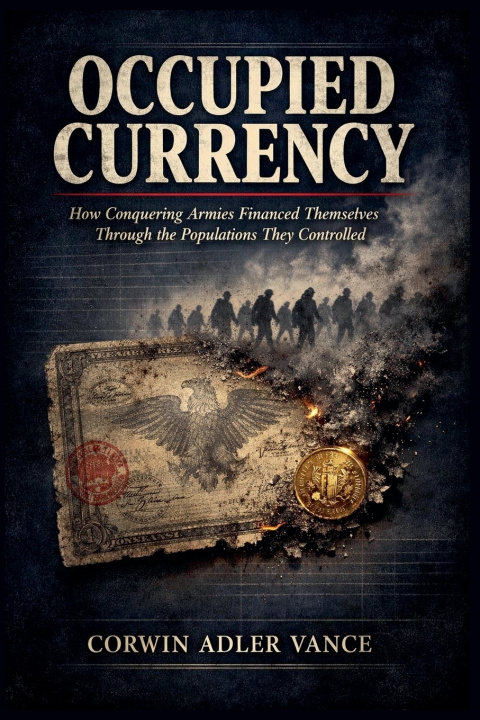
Occupied Currency
How Conquering Armies Financed Themselves Through the Populations They Controlled
 Angielski
 66 b
66 b
 Zapowiedź
 Nowość
Nawet do 30 dni na zwrot

An army does not run on courage alone. It runs on money, and someone always pays the bill.
For two thousand years, conquering powers have understood a truth most history books leave out: occupation is not just about tanks, soldiers, and stolen territory. It is about currency. About exchange rates fixed by decree. About a captured central bank forced to print the very notes that will finance its own captivity. Occupied Currency pulls back the curtain on this hidden architecture of war, tracing it from the tribute rolls of Roman Sicily to the banana money that reduced Singapore's economy to rubble, from Napoleon's calculated indemnities to the Reichskreditkassen notes that drained France more thoroughly than any other nation in occupied Europe.
This is the story economists have quietly documented for decades but popular history has rarely told. Alan Milward's archival discovery that France financed nearly a fifth of Germany's entire war effort. The four hundred seventy six million Reichsmark loan that Greece was forced to extend at gunpoint, dressed up in the polite vocabulary of legitimate finance while famine spread through Athens. The Filipino children who used worthless occupation scrip as playing cards, a currency so debased it earned the nickname Mickey Mouse money. The egg that cost three cents in Singapore before the war and one hundred dollars by the time Japan's occupation currency finally collapsed.
Corwin Adler Vance writes with the pace of a thriller and the rigor of an archive. Every figure in this book is drawn from verified sources: Nuremberg tribunal documents, Reichsbank records, postwar economic reconstructions by historians who spent careers untangling deliberately obscured clearing accounts. Nothing here is invented. The horror does not need embellishment.
What emerges is a single, unsettling argument that runs through every chapter: money is never neutral. It is the quietest, most efficient weapon a conqueror can wield, because unlike a rifle, it does its work without anyone needing to notice. A currency decree does not make headlines. It does not have a face. But it can drain a nation more completely than an army of occupation ever could, and it can keep draining that nation for years after the soldiers have gone home.
You will meet the baker in Lille watching his prices climb three times in a single month. The Greek family burying a relative during the famine winter of 1941. The vegetable seller in Manila revising her chalk prices before the ink is even dry. And you will meet the financial planners in Berlin and Tokyo who built the machinery that made all of it possible, men who understood, with chilling precision, that a captured currency is worth more than a captured city.
Occupied Currency does not ask you to choose between the human cost of occupation and its financial mechanics. It shows you, chapter by chapter, country by country, that they were always the same story. This is narrative history built for readers who want to understand not just what happened in the Second World War and the centuries that shaped it, but how it was paid for, and by whom.
If you have ever wondered what really happens to a nation's money when its government falls, or why some occupied economies collapsed into ruin while others quietly recovered within a decade, this book will change how you read every war story that comes after it. Read the first chapter. You will not want to stop until the last page.


Informacje o książce
Angielski

Podaruj tę książkę jeszcze dziś
To łatwe
1 Dodaj książkę do koszyka i wybierz „dostarczyć jako prezent” 2 W odpowiedzi wyślemy Ci bon 3 Książka dotrze na adres obdarowanegoCześć! Jestem Libroamiko, Twój doradca książkowy.
Jak mogę Ci pomóc?