
 Kontakt
 Jak kupować
Dostawa
Doradca ds. zakupów
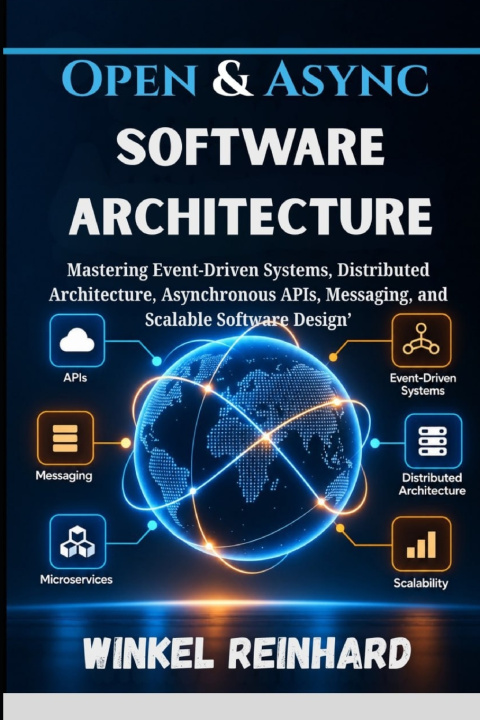
Open & Async Software ArchitectureOpen & Async Software Architecture
Mastering Event-Driven Systems, Distributed Architecture, Asynchronous APIs, Messaging, and Scalable Software Design.
 Angielski
 51 b
51 b
 Zapowiedź
 Nowość
Nawet do 30 dni na zwrot

Modern distributed software is no longer defined by a single application, a single database, or a single request-response path. As systems grow across services, teams, regions, and workloads, architecture must account for independent change, asynchronous communication, distributed state, partial failure, and continuous evolution.
Open & Async Software Architecture presents an advanced approach to designing distributed systems around these realities. It explores event-driven architecture, asynchronous APIs, messaging, distributed workflows, consistency, resilience, scalability, observability, security, and architectural evolution as interconnected disciplines.
This is the advanced volume in a three-book progression from asynchronous programming to practical asynchronous architecture and finally to system-level distributed architecture. The manuscript explicitly positions Book 3 for architects, principal engineers, senior developers, and technical leaders who need to reason about complex production systems.
Rather than promoting a single framework or technology, the book focuses on architectural reasoning, patterns, trade-offs, and principles that can be applied across technology stacks.
The book moves from advanced foundations of open and asynchronous architecture into complex event-driven systems, asynchronous service interfaces, messaging at scale, distributed workflows, consistency models, resilience engineering, scalability, observability, security, and production-grade architecture.
The emphasis is not simply on making systems asynchronous. It is on designing systems that can remain resilient, scalable, observable, secure, loosely coupled, and evolvable as requirements, workloads, teams, and dependencies change.
What's inside:
Explore advanced event modeling, event collaboration, event streams, reactive processing, asynchronous request patterns, webhooks, callbacks, idempotency, API evolution, message routing, partitioning, ordering, delivery semantics, consumer groups, high-volume messaging, orchestration, choreography, sagas, compensation, long-lived workflows, eventual consistency, replication, conflict resolution, backpressure, load shedding, circuit breakers, adaptive recovery, sharding, capacity planning, distributed tracing, operational metrics, security, threat modeling, migration strategies, architectural anti-patterns, and evolutionary architecture.
The appendices provide architecture patterns, distributed-systems checklists, reliability and production-readiness guidance, a glossary, a progression from the earlier books, and an architecture review framework.
This book is designed for software architects, principal engineers, senior software developers, technical leads, distributed-systems engineers, platform engineers, and experienced developers working with complex production environments.
It is particularly suited to readers who already understand asynchronous programming and basic service architecture and are ready to reason about system-wide concerns such as failure domains, consistency, scalability, observability, security, and architectural evolution.
Open and asynchronous architecture embraces these realities instead of treating them as exceptional conditions. The result is a way of designing software around independent progress, controlled coordination, graceful failure, and continuous evolution.
Develop the architectural reasoning required to design systems that can operate effectively across time, services, teams, and scale.
Learn how to connect event-driven design, asynchronous APIs, messaging, distributed workflows, consistency, resilience, scalability, observability, and security into coherent production architecture - and make better architectural decisions when systems become too complex for simple synchronous designs.


Informacje o książce
Angielski

Podaruj tę książkę jeszcze dziś
To łatwe
1 Dodaj książkę do koszyka i wybierz „dostarczyć jako prezent” 2 W odpowiedzi wyślemy Ci bon 3 Książka dotrze na adres obdarowanegoCześć! Jestem Libroamiko, Twój doradca książkowy.
Jak mogę Ci pomóc?