
 Kontakt
 Jak kupować

Dostawa
Doradca ds. zakupów
 Angielski
 41 b
 Zapowiedź
 Nowość
Nawet do 30 dni na zwrot

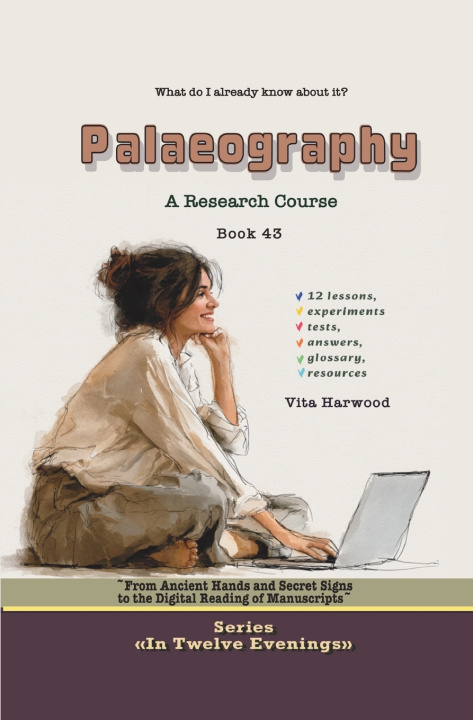
Palaeography
From Ancient Hands and Secret Signs to the Digital Reading of Manuscripts
A Research Course
Vita Harwood
Series "In Twelve Evenings" BOOK 43
What Do I Already Know About This?
Test your knowledge!
Have you ever held an old letter, a parish record or a page from a medieval book and felt that the handwriting was a locked door? This book hands you the keys.
Palaeography is the study of old handwriting: how people wrote, what they wrote on, and how we read their words centuries later. It sounds like a job for archivists in white gloves. In fact it is detective work, and anyone willing to look closely can learn its methods.
In twelve evenings you will learn to read a page before you read a single word. You will build an alphabet for one scribe's hand, see how papyrus, parchment and paper change the shape of a letter, and follow the road from Roman capitals to the lowercase letters on your screen. You will meet the two Slavonic alphabets, look at Arabic, Hebrew and Chinese writing, unpick medieval abbreviations, date a manuscript, tell an honest correction from a forgery, and watch erased texts come back under spectral cameras.
Along the way, a few surprises:
• The & sign began life as two Latin letters, e and t.
• The ink that made medieval writing last can slowly eat through the page.
• Saint Cyril, who gave Cyrillic its name, most probably created a different alphabet.
• A thirteenth-century prayer book hid unique works of Archimedes beneath its prayers.
• Radiocarbon dates the animal skin, not the day the pen touched it.
Every lesson brings a portrait of a scholar who changed the field, from the Benedictine monk who gave palaeography its name to the Vatican librarian who began putting manuscripts online. You also get a Plot Twist that takes apart a popular myth, the key terms, a ten-question test with explained answers, and a field task you can do at home with images from digital libraries. Throughout the course you keep a Manuscript Dossier, and by the last evening it becomes a short research description of a real manuscript you chose yourself.
No Latin, Greek or Old Church Slavonic required. Bring curiosity and the patience to look before you guess.
A book for family historians, lovers of history and old books, writers, students, and anyone who has wondered how scholars read what time has nearly erased.
Part of the series In Twelve Evenings: a whole science in twelve evenings.


Informacje o książce
Angielski

Podaruj tę książkę jeszcze dziś
To łatwe
1 Dodaj książkę do koszyka i wybierz „dostarczyć jako prezent” 2 W odpowiedzi wyślemy Ci bon 3 Książka dotrze na adres obdarowanegoCześć! Jestem Libroamiko, Twój doradca książkowy.
Jak mogę Ci pomóc?