
 Kontakt
 Jak kupować
Dostawa
Doradca ds. zakupów
Physical Computing
 Angielski
 61 b
61 b
 Zapowiedź
 Nowość
Nawet do 30 dni na zwrot

ABOUT THE BOOK
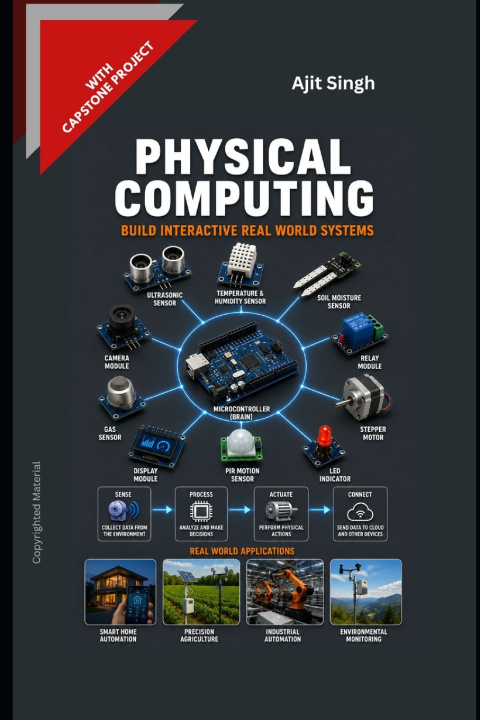
Physical Computing is an exhaustive, strictly practical, and highly focused technical manual designed to take readers from absolute scratch to the final production and deployment of interactive, hardware-software integrated systems. Recognizing the massive paradigm shift in the modern tech industry, this book discards heavy, abstract theory in favor of actionable, step-by-step implementation. This section details the core philosophy, the pedagogical structure, key features, target audience, and the essential takeaways of the text.
Philosophy
The guiding philosophy of this book is strictly application-oriented: Learning by building. The modern technological landscape-dominated by the Internet of Things (IoT), smart infrastructure, embedded systems, and automation-does not value theoretical knowledge in isolation. Industry requires professionals who can physically connect a sensor, write the algorithmic logic to process its data, design a scalable cloud architecture to store that data, and deploy the entire package as a reliable product.
Key Features
This text is packed with features specifically engineered for industry relevance and practical execution:
1. End-to-End Coverage: The text covers the entire lifecycle of a physical computing device: Design, Model, Architecture, Framework, Services, Components, Implementation, Setup, Deployment, Functioning, and Final Production.
2. Strict 10-Chapter Structure: The book is intentionally constrained to 10 highly focused chapters to prevent scope creep and maintain a tight, logical progression.
3. Live DIY Capstone Project: Chapter 10 is exclusively dedicated to a complete, live, working DIY capstone project. It includes all wiring, complete working code, and step-by-step explanations, proving the concepts taught in the first nine chapters.
4. Case Studies and Practical Examples: Every chapter includes real-life case studies demonstrating how the topics are used in agriculture, manufacturing, smart homes, and consumer electronics.
5. Future Scope Integration: Every chapter discusses the future scope of the technologies covered, ensuring the reader is prepared for upcoming industry demands, including AI at the edge and advanced automation.
Key Takeaways
Upon completing this book and its hands-on practicals, the reader will possess the following concrete skills:
1. The ability to identify, select, and integrate the correct sensors, actuators, and microcontrollers for any specific real-world problem.
2. The capacity to write clean, efficient, step-by-step algorithmic code to control physical hardware.
3. A thorough understanding of communication protocols and how to network physical devices locally and globally.
4. The expertise to design secure, scalable cloud architectures and deploy edge-computing frameworks.
5. The practical knowledge to take a prototype from a rough, wired breadboard to a deployed, industrially viable product.
Disclaimer: Earnest request from the Author.
Kindly go through the table of contents and refer kindle edition for a glance on the related contents.
Thank you for your kind consideration!


Informacje o książce
Angielski
