
 Kontakt
 Jak kupować
Dostawa
Doradca ds. zakupów
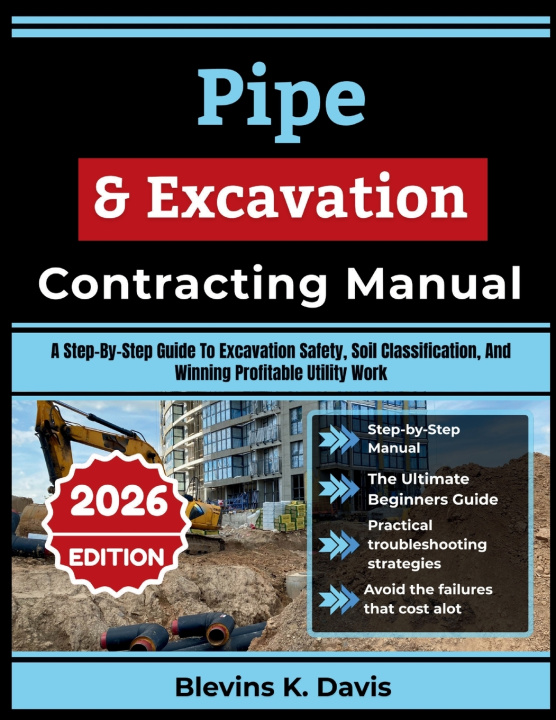
Pipe & Excavation Contracting Manual
A Step-By-Step Guide To Excavation Safety, Soil Classification, And Winning Profitable Utility Work
 Angielski
 243 b
243 b
 Nowość
najlepszej
ceny ▸
Nawet do 30 dni na zwrot

Pipe & Excavation Contracting Handbook 2026 is your complete, practical guide to understanding, estimating, installing, inspecting, and managing every dimension of underground utility construction - explained in plain field language, proven with real production numbers and regulatory specifics, and current to the standards and enforcement environment contractors face right now.
This book was written for you if you are:
- A contractor breaking into or scaling up in the underground utility business and needing a complete, current reference from licensing through closeout
- A field superintendent responsible for trench safety compliance and daily production decisions in an era of $156,259 OSHA violation penalties
- An estimator building accurate bids from scratch - labor, equipment, materials, and overhead - and calibrating productivity assumptions to your actual conditions
- A contractor licensing exam candidate who needs comprehensive technical, safety, and business coverage in a single volume
- A safety officer building a trench safety and confined space entry program that meets the current NEP enforcement posture
- An experienced pipe layer or equipment operator who wants the technical foundation behind the decisions made every day at the trench edge
Inside, You Will Learn How to:
- Build a cost estimate from scratch - all-in labor rates, equipment ownership costs, productivity calibration, and overhead recovery that keeps bids competitive and profitable
- Classify soil correctly every time - OSHA Type A, B, and C field testing with penetrometer readings, disqualifying conditions, and the protective system requirements that follow each classification
- Navigate 29 CFR 1926 Subpart P with complete operational detail - competent person duties and authority, the National Emphasis Program inspection triggers, willful violation penalties, and criminal referral risk
- Execute water main pressure testing and disinfection per AWWA C600 and C651 - allowable leakage calculations, chlorination methods, bacteriological sampling, and tie-in protocols
- Install gravity sewers correctly - manhole construction, drop connections, air testing, video inspection, and the specific conditions that produce rejection-free CCTV results
- Deploy all four primary trenchless methods - HDD bore planning and pullback, pipe bursting (static and pneumatic with upsizing limits), CIPP lining with UV curing, and microtunneling with laser guidance
- Handle rock excavation profitably - hydraulic breaking, rock sawing, and blasting production realities with accurate documentation for differing site condition claims
- Use GPS machine control, AI-powered estimating, drone volumetrics, and equipment telematics to compete with the contractors who have already adopted these tools
- Write notices, manage change orders, document differing site conditions, and close out projects completely - collecting every dollar earned before the final check clears
Bonus Field Reference Section - Your On-Site Toolkit:
- OSHA 29 CFR 1926 Subpart P Daily Trench Inspection Checklist
- Soil Classification Field Decision Tree
- Pipe Material Selection Matrix Productivity Rate Reference Tables
- Productivity Rate Reference Tables
If you are ready to build your underground utility contracting knowledge on a 2026-current foundation - from the licensing requirements and bonding strategy through the trenchless capabilities and technology investments that define competitive contracting today - this is your essential professional reference.
Scroll up and get your copy today - and start building the underground infrastructure that communities depend on, with the technical depth, regulatory currency, and business discipline that lasting success in this trade demands.


Informacje o książce
Angielski

Podaruj tę książkę jeszcze dziś
To łatwe
1 Dodaj książkę do koszyka i wybierz „dostarczyć jako prezent” 2 W odpowiedzi wyślemy Ci bon 3 Książka dotrze na adres obdarowanegoCześć! Jestem Libroamiko, Twój doradca książkowy.
Jak mogę Ci pomóc?