
 Kontakt
 Jak kupować
Dostawa
Doradca ds. zakupów
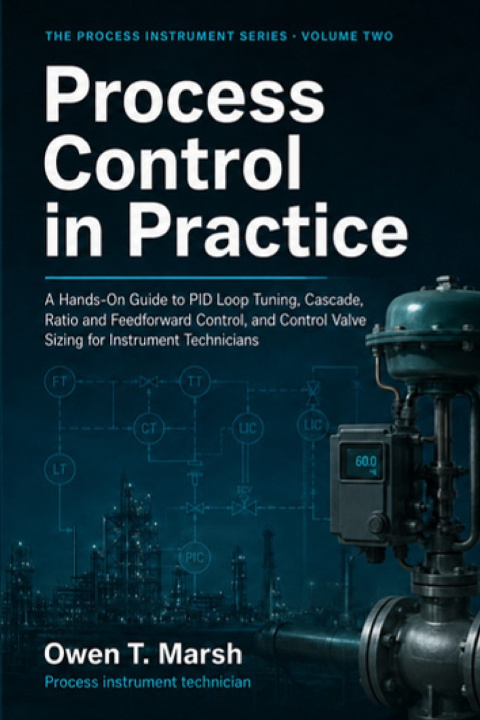
Process Control in Practice
A Hands-On Guide to PID Loop Tuning, Cascade, Ratio and Feedforward Control, and Control Valve Sizing for Instrument Technicians
 Angielski
 103 b
103 b
 Zapowiedź
 Nowość
Nawet do 30 dni na zwrot

PID tuning is the last home of folklore in the plant - rules handed down, numbers copied from one loop to the next, and a widespread belief that it is an art.
It is not. It is a procedure that starts from a measurement of how the process actually responds, and the reason almost nobody does it is that almost no book explains how to make that measurement. This one starts there.
It is written for the technician who has to make a plant hold a value and then defend the result - and it teaches the honest truth most books avoid: a loop that will not hold almost always has its problem OUTSIDE the controller, in the measurement, the valve, or the process dynamics. Changing the gains only hides it.
• **The step test** - how to measure process gain, dead time and time constant off a trend with a ruler. No Laplace transform appears anywhere in the book.
• **Tuning as a procedure** - with a defined stopping point, and the dead-time-to-time-constant ratio that tells you honestly when tuning cannot help at all.
• **Valves for real** - characteristic, authority, the installed characteristic, and why an oversized valve controls only in the first fifth of its travel.
• **The structures a single loop cannot replace** - cascade on the dead-time-bound chlorine loop, ratio on the coagulant dose, feedforward, override, split range, and the two loops that fight each other until you deliberately slow one down.
• **Diagnosis from the trend** - telling bad tuning from a sticking valve from a dead-time-bound loop, each by its signature.
Every chapter ends by producing a completed field document - a step test record, a tuning record, a valve sizing sheet, an oscillating-loop diagnosis, a commissioning report - filled in with real numbers and reproducible with a pen. The blank forms are collected in Appendix D to photocopy.
**No brand names anywhere.** The volume runs on one fictional plant - Ashford Bend Water Treatment Plant - the same plant as Volume 1. Volume 1 is not a prerequisite, but this book assumes the measurement is already trustworthy; making it trustworthy is Volume 1's subject.


Informacje o książce
Angielski
