
 Kontakt
 Jak kupować
Dostawa
Doradca ds. zakupów
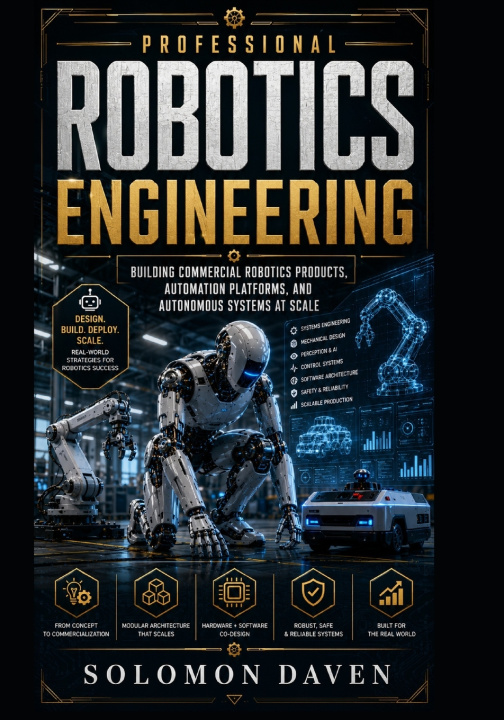
Professional Robotics Engineering
Building Commercial Robotics Products, Automation Platforms, and Autonomous Systems at Scale
 Angielski
 45 b
45 b
 Zapowiedź
 Nowość
Nawet do 30 dni na zwrot

Professional Robotics Engineering is a practical, industry-focused guide to designing, building, and scaling real-world robotics systems that go beyond prototypes and academic demos. It is written for engineers who want to move into production-grade robotics development, where reliability, performance, and system integration matter more than isolated experiments.
Most robotics content stops at small projects or simulated examples. This book goes further. It focuses on what it actually takes to build robotics systems that can operate in real environments, handle failure conditions, process continuous sensor streams, and scale across multiple devices or deployments. The emphasis is on engineering discipline, system architecture, and production-ready implementation.
Modern robotics success is not defined by whether a robot can move or detect objects. It is defined by whether the system can run continuously, respond safely under uncertainty, integrate multiple sensors reliably, and maintain performance under real-world constraints such as noise, latency, hardware variation, and environmental unpredictability.
This book is written for:
- Robotics engineers moving from prototypes to production systems
- AI and machine learning engineers building embodied intelligence systems
- Software engineers transitioning into robotics and automation platforms
- Computer vision engineers working on real-time perception systems
- Developers building autonomous navigation, mapping, and control systems
- Technical founders building robotics startups or automation products
- Students and researchers aiming to work in industrial robotics or autonomous systems
The book focuses heavily on system-level engineering. Readers will learn how to design full robotics architectures that integrate perception pipelines, sensor fusion layers, SLAM systems, decision-making engines, and real-time control loops. Instead of treating these components separately, the book shows how they interact inside a single operational system.
A key focus is scalability. Many robotics systems fail not at the algorithm level, but at the integration level when moving from one robot to many. This book explains how to design modular architectures that can scale across fleets of robots, distributed systems, or industrial environments without breaking consistency or performance.
It also covers reliability engineering. Real robotics systems must handle partial sensor failure, communication delays, unpredictable environments, and hardware inconsistencies. The book explains how to design fallback behaviors, safety layers, monitoring systems, and recovery mechanisms that keep robots operational even under degraded conditions.
Another major theme is real-time performance. Robotics is not batch processing. Every decision is time-sensitive. The book teaches how to structure systems that meet strict latency requirements while maintaining accuracy and stability across perception, planning, and control layers.
Rather than focusing on isolated algorithms, the book emphasizes complete workflows. Readers will see how perception feeds into mapping, how mapping supports planning, how planning connects to control, and how decision systems coordinate everything into a coherent behavior model.
By the end of the book, readers will understand how to design and build production-grade robotics systems that can operate in real environments, scale across deployments, and meet industrial reliability standards. More importantly, they will understand how to think like robotics system engineers rather than experiment-level developers.
This is not a beginner introduction to robotics. It is a practical engineering reference for building commercial-grade autonomous systems and robotics platforms that work outside the lab and into the real world.


Informacje o książce
Angielski

Podaruj tę książkę jeszcze dziś
To łatwe
1 Dodaj książkę do koszyka i wybierz „dostarczyć jako prezent” 2 W odpowiedzi wyślemy Ci bon 3 Książka dotrze na adres obdarowanegoCześć! Jestem Libroamiko, Twój doradca książkowy.
Jak mogę Ci pomóc?