
 Kontakt
 Jak kupować
Dostawa
Doradca ds. zakupów
 Angielski
 25 b
25 b
 Nowość
najlepszej
ceny ▸
Nawet do 30 dni na zwrot

Hannibal, the general who nearly destroyed Rome, once called a certain king the greatest soldier the world had ever seen, ahead of everyone, ahead even of himself. Most people today have never heard of him. He spent his whole life winning battles and ended with nothing to show for any of them.
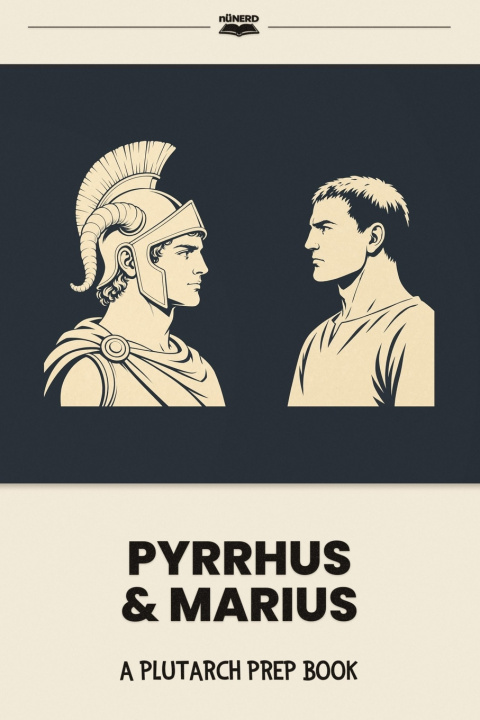
Much of what we know about that king comes from the Greek biographer Plutarch. This book sets him beside a Roman who looked like his opposite: Gaius Marius, a farm boy with no name and no money who clawed his way up to save Rome from destruction, and then spent his last years turning that same Rome into a place of fear. Two of the most gifted soldiers of the ancient world. Both ended with almost none of what all that winning was supposed to buy. The whole book is built to let your reader work out why.
Plutarch wrote these two as a matched pair, a Greek beside a Roman, so that a reader would weigh one against the other and reach a verdict. He usually ended each pair with a short essay giving his own judgment. For Pyrrhus and Marius he wrote that essay too. It is the one piece of his writing on these two men that did not survive. There is no answer key, so the verdict your reader reaches is theirs alone.
So the book teaches your reader to do the weighing. It does not march through two lives and then crown a winner. It takes them one hard question at a time: where each man's gift came from, what that gift could never do, what their victories actually cost, and why neither could ever stop. It shows where the evidence leans hard in one direction, and it is honest about the questions that stay genuinely open, the ones a thoughtful reader could answer either way. It even weighs how well we know each man: the ugliest stretch of Marius's story reaches us through a memoir written by his bitterest enemy, while much of the ancient record of Pyrrhus is simply gone.
This is preparation for Plutarch, not name recognition. Your reader finishes this book able to hold two admirable, dangerous people side by side and argue about them with evidence, the habit Plutarch was trying to teach. And when they open the real Parallel Lives in a few years, Pyrrhus and Marius will not be new names. They will be an argument already in progress.
Have a younger reader too? The toddler book, picture book, and chapter book tell the same two lives, one reading level at a time. This is the top rung.
What this version does. It treats your reader as Plutarch's actual audience: someone old enough to weigh two lives, tell the difference between what we know and what we only think we know, and reach a verdict the lost page leaves open.
Ages 10-14 · about 8,300 words · written for a middle-grade reader · 15 original woodcut-style plates · includes the point-by-point comparison and a source note on how we know · reads solo, built as the on-ramp to Plutarch's own text.
Content note. This book is honest about ancient violence and cruelty, at a level suited to a middle-grade reader. There is war throughout, and both men die by the end. Marius's descent is the hard heart of the book: to hold power he allies with killers, an innocent man is executed on a false charge, and in his final rage he has Roman citizens hunted and murdered in the streets, one of them driven to take his own life. None of it is gratuitous, but the full moral weight is on the page.
Part of the nüNERD Learning System. Every Plutarch pair comes in four reading levels, each built for how children think at that stage, never a leveled-down rewrite. This is the level made to be read right before the real thing.
Also available for Ages 0-4, Ages 3-7, and Ages 6-10.


Informacje o książce
Angielski

Podaruj tę książkę jeszcze dziś
To łatwe
1 Dodaj książkę do koszyka i wybierz „dostarczyć jako prezent” 2 W odpowiedzi wyślemy Ci bon 3 Książka dotrze na adres obdarowanegoCześć! Jestem Libroamiko, Twój doradca książkowy.
Jak mogę Ci pomóc?