
 Kontakt
 Jak kupować
Dostawa
Doradca ds. zakupów
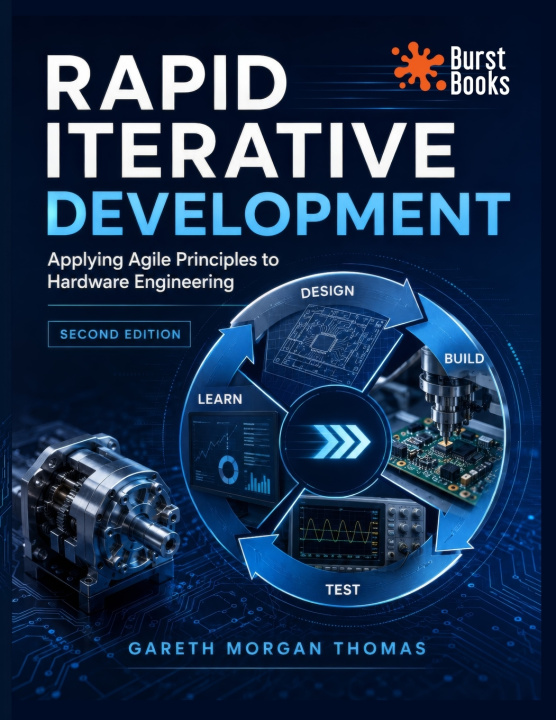
Rapid Iterative Development Second Edition
Applying Agile Principles to Hardware Engineering
 Angielski
 58 b
58 b
 Zapowiedź
 Nowość
Nawet do 30 dni na zwrot

Most hardware teams don't have an engineering problem.
They have a learning-speed problem.
A design looks good on paper. The simulations work. The reviews are complete.
Then reality arrives.
A component interferes with another. A supplier changes the constraints. A prototype exposes a hidden failure mode. Manufacturing reveals assumptions nobody tested. Software and hardware stop agreeing.
And suddenly the cost of learning becomes enormous.
Rapid Iterative Development: Applying Agile Principles to Hardware Engineering, Second Edition shows how high-performing engineering teams discover what is wrong, prove what is right, and make better decisions before uncertainty becomes expensive.
This is not software Agile awkwardly transplanted into the physical world.
Hardware has materials, tooling, lead times, suppliers, manufacturing constraints, safety limits, irreversible decisions, and real capital at risk.
The answer is a disciplined system for accelerating the design-build-test-learn cycle.
Inside, you'll learn how to:
Turn prototypes into deliberate experiments that answer consequential engineering questions.
Choose the right prototype fidelity instead of wasting time and money building more than the current decision requires.
Expose dangerous assumptions early while they are still cheap and manageable to correct.
Use CAD, CAE, simulation, digital twins, telemetry, SIL, HIL, and automated testing to accelerate engineering learning.
Reduce feedback latency between a design decision, physical evidence, and corrective action.
Build cross-functional teams that can iterate across mechanical, electrical, firmware, software, manufacturing, and supply-chain disciplines.
Scale iteration from early prototypes through EVT, DVT, PVT, production, and field learning.
Measure what matters: learning velocity, cycle time, evidence quality, risk retirement, first-pass yield, rework, and the economics of iteration.
Move faster without sacrificing rigor, traceability, quality, or safety.
The objective is not simply to build prototypes quickly.
The objective is to eliminate consequential uncertainty faster than the competition.
An organization that can run more decisive learning cycles can discover stronger architectures sooner, kill weak ideas before they consume serious capital, resolve integration problems while they are still controllable, and reach production with better evidence.
Whether you work in robotics, aerospace, automotive systems, electronics, industrial equipment, energy, medical devices, advanced manufacturing, or hardware-software products, the governing principle is the same:
Do not wait for reality to reveal your mistakes at the most expensive possible moment.
Build the system that finds them first.
Rapid Iterative Development gives you the engineering framework for learning faster, retiring technical risk earlier, and delivering better hardware sooner.


Informacje o książce
Angielski
