
 Kontakt
 Jak kupować
Dostawa
Doradca ds. zakupów
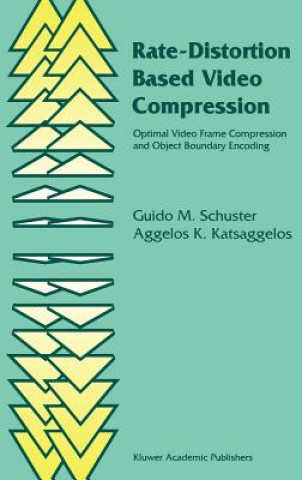
Rate-Distortion Based Video Compression
Optimal Video Frame Compression and Object Boundary Encoding
 Angielski
 373 b
373 b
30 dni na zwrot towaru
Klienci kupili także











 /
/
 Miękka
 208.21
zł
208.21
zł





One of the most intriguing problems in video processing is the removal of the redundancy or the compression of a video signal. There are a large number of applications which depend on video compression. Data compression represents the enabling technology behind the multimedia and digital television revolution. In motion compensated lossy video compression the original video sequence is first split into three new sources of information, segmentation, motion and residual error. These three information sources are then quantized, leading to a reduced rate for their representation but also to a distorted reconstructed video sequence. After the decomposition of the original source into segmentation, mo tion and residual error information is decided, the key remaining problem is the allocation of the available bits into these three sources of information. In this monograph a theory is developed which provides a solution to this fundamental bit allocation problem. It can be applied to all quad-tree-based motion com pensated video coders which use a first order differential pulse code modulation (DPCM) scheme for the encoding of the displacement vector field (DVF) and a block-based transform scheme for the encoding of the displaced frame differ ence (DFD). An optimal motion estimator which results in the smallest DFD energy for a given bit rate for the encoding of the DVF is also a result of this theory. Such a motion estimator is used to formulate a motion compensated interpolation scheme which incorporates a global smoothness constraint for the DVF.


Informacje o książce
Angielski
Kategoria

Podaruj tę książkę jeszcze dziś
To łatwe
1 Dodaj książkę do koszyka i wybierz „dostarczyć jako prezent” 2 W odpowiedzi wyślemy Ci bon 3 Książka dotrze na adres obdarowanegoMogłoby Cię także zainteresować




 /
Miękka
38.35
zł
/
Miękka
38.35
zł



 /
Miękka
63.22
zł
/
Miękka
63.22
zł






 /
/
 CD Audio
156.76
zł
CD Audio
156.76
zł


 /
Miękka
108.02
zł
/
Miękka
108.02
zł
 /
Miękka
118.40
zł
/
Miękka
118.40
zł


 /
Miękka
85.98
zł
/
Miękka
85.98
zł
Cześć! Jestem Libroamiko, Twój doradca książkowy.
Jak mogę Ci pomóc?