
 Kontakt
 Jak kupować
Dostawa
Doradca ds. zakupów
 Angielski
 26 b
26 b
 Nowość
Nawet do 30 dni na zwrot

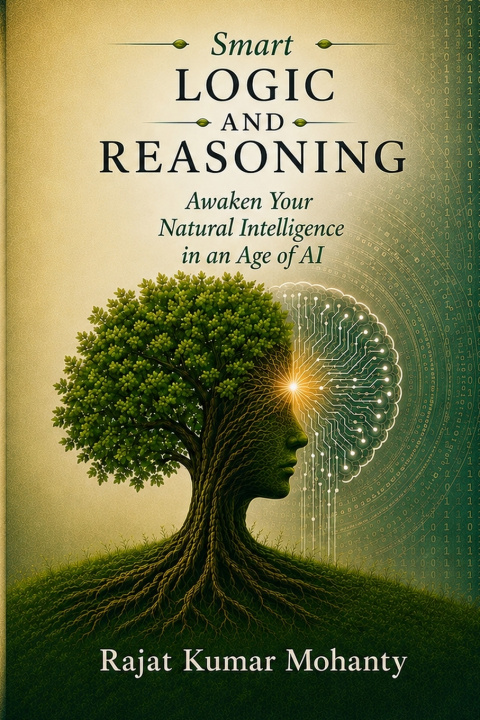
Smart Logic and Reasoning: Awakening Natural Intelligence in an Age of AI
How can people think clearly when information is abundant and convincing answers are available instantly?
Every day, people make decisions, evaluate claims, interpret evidence, and choose between competing explanations. Yet having information is not the same as knowing how to reason about it. Good reasoning requires questioning assumptions, evaluating evidence, recognizing uncertainty, comparing alternatives, and justifying conclusions.
This challenge has become especially important in the age of artificial intelligence. AI systems can retrieve information, analyze data, summarize complex material, and generate remarkably fluent answers. But an answer that sounds convincing is not necessarily correct. The ability to evaluate what an answer means, how it was derived, and whether it deserves to be trusted remains essential.
Smart Logic and Reasoning explores how people reason and how different forms of reasoning work together. It moves from clear thinking to deduction, induction, abduction, and analogy, then to logical fallacies, critical evaluation, scientific inquiry, research, decision-making, and reasoning with AI.
Rather than presenting logic as a collection of abstract rules or examination tricks, the book treats reasoning as a practical expression of natural intelligence. It progresses from clear thinking to individual reasoning patterns, from critical evaluation to integrated reasoning, showing how these approaches work together when real problems must be understood and decisions made.
The book explores four major patterns:
- Deductive reasoning: What must follow if the premises are true?
- Inductive reasoning: What broader conclusion is supported by the available evidence?
- Abductive reasoning: What is the most plausible explanation for what has been observed?
- Analogical reasoning: What can meaningful similarities reveal about a new problem?
It then examines logical fallacies, cognitive biases, evidence, correlation and causation, scientific reasoning, research, professional judgment, and AI-generated information. The final chapters show how reasoning patterns can be selected, combined, evaluated, and revised in complex situations.
A special treatment of categorical syllogisms introduces their classical structure, propositions, terms, mood, figure, validity, and traditionally valid forms. An appendix provides a reference guide to valid syllogistic forms and examples.
Throughout the book, reasoning is applied to everyday decisions, news and social media, research, professional judgment, scientific inquiry, analytical reasoning, and AI-generated information.
The book is designed for a broad audience.
Students preparing for UPSC, SSC and other competitive examinations can strengthen the conceptual foundations of logical reasoning, analytical ability, critical thinking, and problem-solving.
University students, researchers, teachers, and professionals can use the frameworks to examine evidence, construct arguments, evaluate alternatives, and make more defensible decisions.
General readers and curious thinkers can develop a more deliberate habit of questioning, evaluating, and revising their conclusions.
The central message is simple:
Good reasoning is not about relying on a single method. It is about knowing how to select, combine, evaluate, and revise different forms of reasoning as circumstances change.
In an age when information and artificial intelligence are expanding rapidly, natural intelligence does not become less important. It becomes more important.
The goal is not perfect reasoning. It is progressively better reasoning.


Informacje o książce
Angielski

Podaruj tę książkę jeszcze dziś
To łatwe
1 Dodaj książkę do koszyka i wybierz „dostarczyć jako prezent” 2 W odpowiedzi wyślemy Ci bon 3 Książka dotrze na adres obdarowanegoCześć! Jestem Libroamiko, Twój doradca książkowy.
Jak mogę Ci pomóc?