
 Kontakt
 Jak kupować

Dostawa
Doradca ds. zakupów
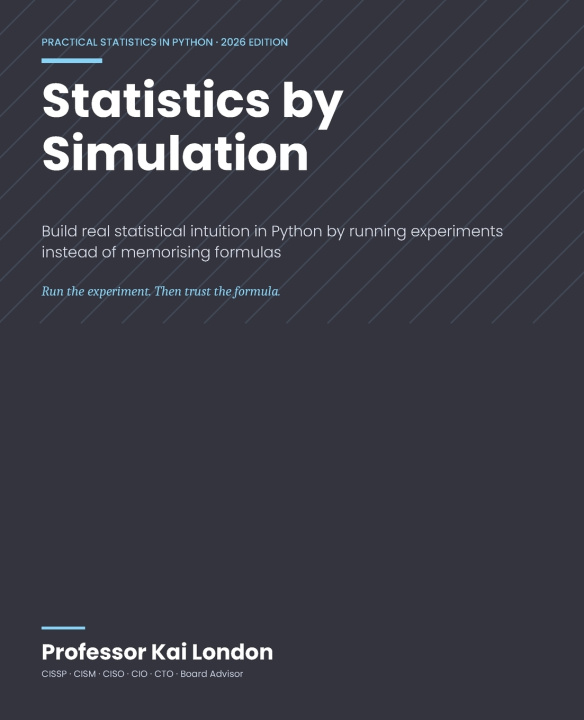
Statistics by Simulation
Build real statistical intuition in Python by running experiments instead of memorising formulas
 Angielski
 304 b
 Zapowiedź
 Nowość
Nawet do 30 dni na zwrot

Statistics by Simulation: Build real statistical intuition in Python by running experiments instead of memorising formulas
You can run a pandas script and draw a chart, yet the moment someone asks whether a result is real, the confidence drains away. Formulas on the page feel arbitrary, textbooks bury the idea under notation, and online tutorials tell you which function to call without telling you why it works.
Statistics by Simulation takes a different route. Every major idea in introductory statistics is something you can watch happen on your own computer. You will flip virtual coins ten thousand times, draw samples from skewed populations, build confidence intervals and count how often they miss, then run an A/B test thousands of times to see exactly how often a real effect goes undetected. When the formula finally appears, it describes something you have already seen.
The book works through twelve chapters: variability and visualisation, probability by simulation, conditional probability and Bayes, distributions and sampling, the central limit theorem, confidence intervals, hypothesis tests and p-values, effect sizes and power, regression assumptions, resampling and the bootstrap, Bayesian inference, and communicating uncertainty to people who must make decisions.
You will build three capstone projects: a coin-flip probability simulator with a test suite, an A/B test power study that tells you how many users an experiment really needs, and a bootstrap investigation that compares interval methods on awkward real-world data.
All code uses Python with NumPy, pandas, SciPy, Matplotlib and statsmodels, and every listing is designed to run as written. Worked examples show inputs and expected outputs, pitfall boxes flag the mistakes analysts make most often, and exercises have clear success criteria so you know when you have understood.
This book is for data analysts, career changers, students and self-taught programmers who want statistics to make sense rather than merely pass a test. You need basic Python and school-level arithmetic. No calculus is required.


Informacje o książce
Angielski

Podaruj tę książkę jeszcze dziś
To łatwe
1 Dodaj książkę do koszyka i wybierz „dostarczyć jako prezent” 2 W odpowiedzi wyślemy Ci bon 3 Książka dotrze na adres obdarowanegoCześć! Jestem Libroamiko, Twój doradca książkowy.
Jak mogę Ci pomóc?