
 Kontakt
 Jak kupować
Dostawa
Doradca ds. zakupów
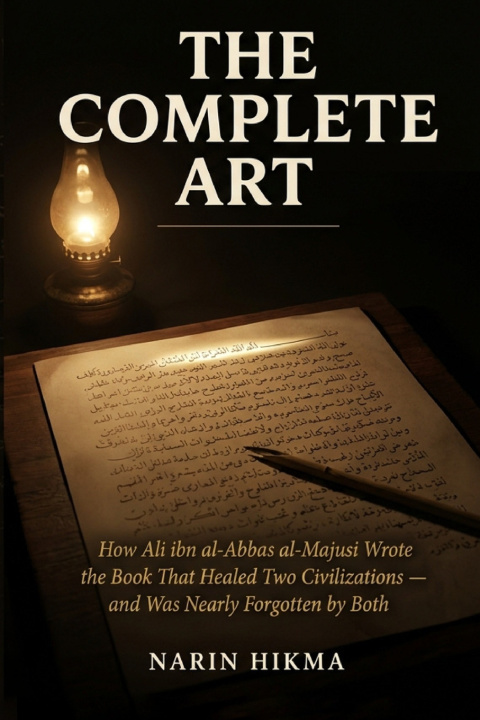
The Complete Art
How Ali ibn al-Abbas al-Majusi Wrote the Book That Healed Two Civilizations - and Was Nearly Forgotten by Both
 Angielski
 37 b
37 b
 Zapowiedź
 Nowość
Nawet do 30 dni na zwrot

The work you do quietly, that nobody signs your name to, may be the most important thing you ever give the world.
You already know this feeling. You have written the document that everyone now uses and nobody attributes. You have trained the person who trains everyone else. You have solved the thing so thoroughly that within a few years it stopped being a thing anyone remembers was ever solved.
A physician in tenth-century Persia knew it too, and his case is the most extreme on record.
Ali ibn al-Abbas al-Majusi was a Muslim of Zoroastrian descent - his own name meant fire-worshipper, and he never took it off. He served a ruler who dammed a river to water three hundred villages, kept a library with a catalogue for every subject, and had a defeated minister trampled to death by elephants. And in the years before that ruler died, he wrote twenty discourses covering the whole of medicine: theory first, then practice, in one architecture a working physician could actually use.
Then a monk at Monte Cassino translated the book into Latin and left the author's name off it.
For the next two and a half centuries, every physician in Latin Europe learned what a human body is from the architecture of that book, under another man's name. The division al-Majusi invented - theory in one half, practice in the other - became the shape of European medicine for four hundred years. Students who had never heard of him spent their working lives inside his filing system.
He left no school. Not one pupil of his is named in any surviving source. What he left was the book, and for eight hundred years strangers copied it out by hand: a Christian scribe in a Kurdish mountain town in 1208, a Jewish physician who later owned that copy in Damascus, the caliph's own doctor writing it out personally in Baghdad in 1219, and a working physician who was still copying the whole thing by hand in 1725, in the age of Newton.
The Complete Art is narrative history. The documented facts are researched and identified as such; the scenes between them are imagined, and the book tells you every time.
- Understand why the most consequential thing a person builds is often the shape of a thing rather than its contents
- Follow a stolen book across the Mediterranean and watch a second translator try to correct the record in 1127 - and lose by more than ten to one
- Meet a patron who built libraries and killed ministers on the same afternoon, and the physician who had to serve both facts at once
- Read a tenth-century surgeon's own instructions for opening a fractured skull, down to the linen soaked in rose water laid on the wound
- Come away able to name the man whose work you have been standing on without knowing it
This is a book for anyone who has done careful work in a room where nobody was watching, and wondered whether it counted.
It counted. It is still counting. Nobody told him either.
Open the first page. He is still there, at the top of the manuscript, where the scribes left him.


Informacje o książce
Angielski

Podaruj tę książkę jeszcze dziś
To łatwe
1 Dodaj książkę do koszyka i wybierz „dostarczyć jako prezent” 2 W odpowiedzi wyślemy Ci bon 3 Książka dotrze na adres obdarowanegoCześć! Jestem Libroamiko, Twój doradca książkowy.
Jak mogę Ci pomóc?