
 Kontakt
 Jak kupować

Dostawa
Doradca ds. zakupów
 Angielski
 163 b
 Zapowiedź
 Nowość
 Wydanie 05. 01. 2027
Nawet do 30 dni na zwrot

A bank that deploys artificial intelligence but governs it with pre-digital controls is not a more efficient institution. It is a faster mechanism for producing correlated failure.
Artificial intelligence is changing banking at a speed no previous technology has matched. Decisions that once took days can now take milliseconds. Credit can be priced, trades executed, fraud detected, liquidity managed and capital allocated by machines operating continuously, learning from data and interacting with one another at scale.
The problem is not whether banks can make these systems work.
The problem is whether they can control them when they do.
The Evolved Bank starts from a simple proposition: the control problem in banking has fundamentally changed. Human governance operates through meetings, committees, reviews and periodic challenge. AI operates continuously. Between human observation points, models drift, systems interact, errors propagate and small changes can become systemic before anyone has recognised that anything has gone wrong.
The result is a new form of institutional risk: correlated failure at machine speed.
The answer is not to slow technology down. Nor is it to bolt another layer of controls onto an architecture designed for a different age. It is to redesign the control architecture itself.
The book identifies the functions that banking cannot abandon - trust intermediation, risk transformation, payment settlement, liquidity provision and the allocation of capital to productive use - and examines what happens when the decisions supporting those functions increasingly move from people to machines.
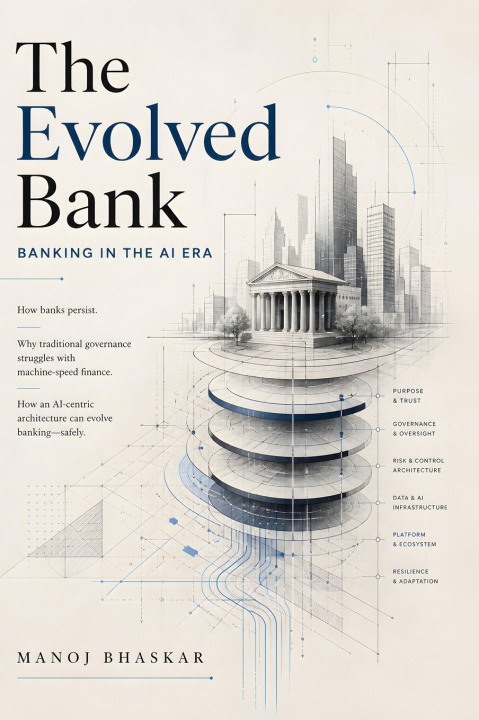
It then sets out a new architecture for the AI-enabled bank. The Three Lines of Defence do not disappear. They become properties of the architecture itself: ownership, challenge and assurance embedded across seven concentric layers, each operating at the speed of the business and each incorporating mechanisms designed to prevent technological monoculture and correlated failure.
But architecture alone is not enough. The Evolved Bank provides a practical path from today's institution to tomorrow's, covering the sequencing of transformation, its economics, the points at which major transformations typically fail, and the governance required to cross the difficult years between the old model and the new.
This creates a systemic risk no individual bank can resolve alone: if institutions increasingly depend on the same models, data, and infrastructure, a failure that appears local may not remain local.
The Evolved Bank is not a book about putting AI into banking. It is a book about rebuilding banking for an age in which machines make the decisions.
For boards, chief executives, chief risk officers, regulators, technology leaders and financial professionals, it provides both the intellectual framework and the practical architecture for navigating the most consequential transformation banking has faced since the digital revolution.


Informacje o książce
Angielski

Podaruj tę książkę jeszcze dziś
To łatwe
1 Dodaj książkę do koszyka i wybierz „dostarczyć jako prezent” 2 W odpowiedzi wyślemy Ci bon 3 Książka dotrze na adres obdarowanegoCześć! Jestem Libroamiko, Twój doradca książkowy.
Jak mogę Ci pomóc?