
 Kontakt
 Jak kupować
Dostawa
Doradca ds. zakupów
 Angielski
 56 b
56 b
 Nowość
najlepszej
ceny ▸
Nawet do 30 dni na zwrot

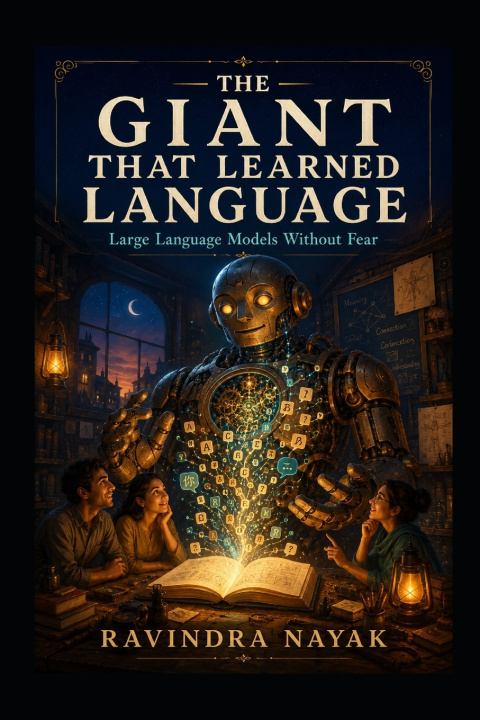
Can a machine truly work with language-or does it only appear to understand us?
Inside a small imaginary workshop, a quiet machine named Echo begins to speak.
Its answers are fluent. Its explanations feel thoughtful. It can rewrite a message, continue a story, organise an idea, and hold a conversation.
But what is actually happening beneath the words?
The Giant That Learned Language takes readers inside the foundations of large language models without assuming a technical background, advanced mathematics, or programming experience.
Instead of beginning with intimidating vocabulary, the journey begins with familiar human experiences: unfinished sentences, ambiguous messages, remembered conversations, useful guesses, misunderstood instructions, and the difference between sounding confident and being correct.
Through the conversations of Noor, Lila, Ishan, Mara, and the evolving workshop, readers gradually discover:
- how machines turn language into tokens they can process,
- why predicting the next token can produce complete explanations and conversations,
- how training changes a model through repeated prediction and correction,
- what billions of parameters actually represent,
- how context windows shape what a model can use at one moment,
- why prompts work best when intention, evidence, audience, and constraints are clear,
- how training knowledge differs from current information,
- why fluent systems can still invent convincing but unsupported details,
- where retrieval, tools, verification, and human judgment become essential,
- and how language models can assist learning, writing, work, creativity, and business without becoming unquestioned authorities.
Child's View → Everyday Example → Real System → Future Possibility
The book does not hide difficult ideas. It rebuilds them patiently.
Probability becomes a way of comparing possible next words. Parameters become billions of adjustable relationships rather than mysterious containers of facts. A context window becomes a working desk beside a much larger library. Prompting becomes the discipline of making an intended outcome visible-not the search for magical phrases.
The concluding Value Edition turns understanding into action. Readers practise breaking complex problems into manageable pieces, examining assumptions, improving questions, evaluating evidence, overcoming mathematical fear, repairing weak prompts, and designing responsible AI-assisted workflows.
This is not a book about worshipping technology or fearing it.
It is a book about seeing clearly.
For students, educators, professionals, founders, career changers, creators, and curious readers, The Giant That Learned Language offers a welcoming path into large language models, generative AI, prompt design, context, verification, and responsible use.
You do not need to understand every technical term before you begin.
You only need one honest question:
What must be happening for this machine to produce language-and what remains our responsibility?


Informacje o książce
Angielski

Podaruj tę książkę jeszcze dziś
To łatwe
1 Dodaj książkę do koszyka i wybierz „dostarczyć jako prezent” 2 W odpowiedzi wyślemy Ci bon 3 Książka dotrze na adres obdarowanegoCześć! Jestem Libroamiko, Twój doradca książkowy.
Jak mogę Ci pomóc?