
 Kontakt
 Jak kupować
Dostawa
Doradca ds. zakupów
 Angielski
 47 b
47 b
 Nowość
najlepszej
ceny ▸
Nawet do 30 dni na zwrot

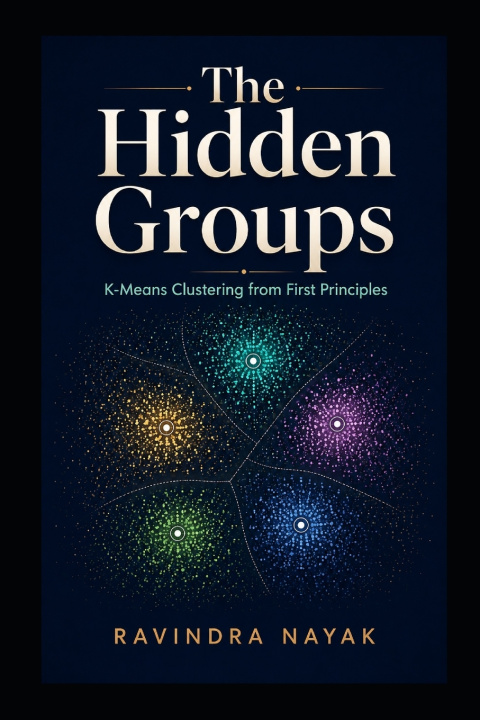
What happens when data arrives without labels-and you still need to make sense of it?
The Hidden Groups is a fear-free, first-principles guide to K-Means clustering for nontechnical readers, complete beginners, students, managers, and curious professionals who want to understand machine learning without beginning with code or advanced mathematics.
Most explanations of clustering start with a formula. This book starts with a human act: noticing that some things seem to belong together. From that familiar doorway, it builds the entire method one careful layer at a time. You will learn how real observations become points, how distance defines similarity, why a centroid acts as a balancing point, what the K in K-Means controls, and how repeated assignment and movement gradually create groups.
Through dialogues, visual explanations, hand-built examples, small calculations, poetry pauses, and practical reflection, the book turns unsupervised learning into something you can inspect rather than merely accept.
Inside, you will learn to:
• distinguish clustering from classification.
• translate people, places, products, documents, or events into features without forgetting what the data leaves out.
• understand coordinates, Euclidean distance, means, centroids, scaling, inertia, convergence, and cluster quality in ordinary language.
• build a complete K-Means model by hand before relying on software.
• compare possible values of K using evidence, stability, interpretability, and purpose.
• recognise the effects of initialization, outliers, overlap, unequal density, non-round groups, mixed data, and high-dimensional spaces.
• connect clusters to limited, responsible actions instead of turning them into permanent labels.
Real-world chapters explore customer behaviour, machine operating modes, city journeys, farm zones, learning patterns, healthcare operations, document themes, and image compression. Every application begins with a human question and ends with a careful examination of usefulness, uncertainty, and consequences.
The final Value Edition helps you reconstruct the method from memory, divide complex problems into manageable decisions, strengthen mathematical confidence, diagnose failure cases, compare method directions, and design a clustering project from purpose to monitoring.
You do not need programming experience. You do not need to be "good at mathematics." You need curiosity, patience, and a willingness to ask what the numbers mean.
The Hidden Groups does not promise that every dataset contains a perfect answer. It offers something more useful: the ability to understand how groups are formed, challenge the assumptions behind them, and explain what the results may-and may not-mean.
Character count, including spaces and line breaks: 2741. This remains within KDP's description limit.


Informacje o książce
Angielski

Podaruj tę książkę jeszcze dziś
To łatwe
1 Dodaj książkę do koszyka i wybierz „dostarczyć jako prezent” 2 W odpowiedzi wyślemy Ci bon 3 Książka dotrze na adres obdarowanegoCześć! Jestem Libroamiko, Twój doradca książkowy.
Jak mogę Ci pomóc?