
 Kontakt
 Jak kupować
Dostawa
Doradca ds. zakupów
 Angielski
 21 b
21 b
 Zapowiedź
 Nowość
Nawet do 30 dni na zwrot

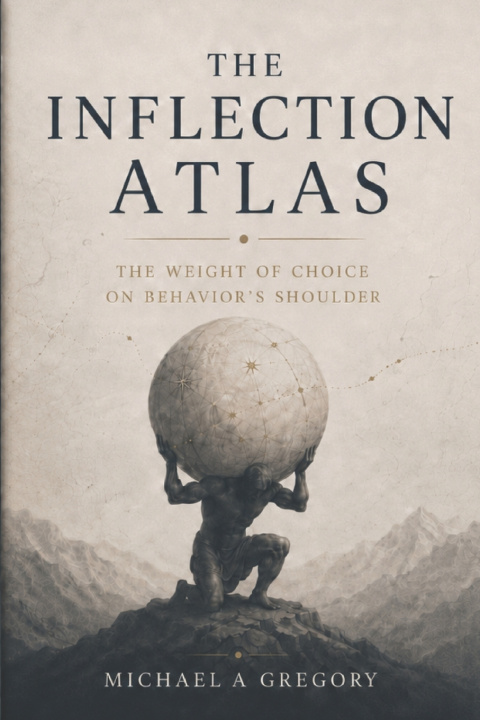
Why do people keep doing what they know is destroying them-and why do harsher consequences so often fail to change anything?
Across addiction, crime, suicide, divorce, education, politics, and recovery, researchers repeatedly encounter the same frustrating pattern: information, punishment, and willpower are often weak levers. Making the current path more painful frequently accomplishes less than making another path genuinely reachable.
The Inflection Atlas develops a unified framework for understanding when behavior turns-and why some turns lead toward recovery while others lead toward ruin.
Michael A Gregory proposes that people and groups organize their behavior around an internal picture of how life should be, pushing continually to close the distance between that picture and reality. A lasting change becomes possible when the current picture begins to lose its hold and a viable alternative is real enough to replace it.
Drawing on public research, government records, behavioral science, control theory, recovery studies, and intelligence tradecraft, the book examines:
• Why "knowing better" rarely guarantees doing better
• Why a home, a job, and a reachable future can outperform harsher punishment
• How identity, community, purpose, and story can transform-or capture-a person
• Why crisis creates an "open moment" when a new direction can take hold
• How the same basic pattern may appear in individuals, relationships, institutions, and civilizations
• Why systems that already know what works continue choosing the weaker response
The framework was developed through an adversarial research process using Claude and ChatGPT-not to endorse the idea, but to attack it, expose its weaknesses, and force revisions when its predictions failed.
This is not a promise to predict what a particular person will do, a clinical treatment, or a manual for controlling people. It is an atlas of conditions: a way to examine what someone is protecting, what alternatives are truly reachable, how close a system may be to turning, and whether the road ahead is widening or narrowing.
Written for counselors, policymakers, researchers, parents, leaders, and anyone who has ever wondered how a person can sincerely want to change and still remain exactly where they are.
The gap reads the weather. It never commands the sky.


Informacje o książce
Angielski

Podaruj tę książkę jeszcze dziś
To łatwe
1 Dodaj książkę do koszyka i wybierz „dostarczyć jako prezent” 2 W odpowiedzi wyślemy Ci bon 3 Książka dotrze na adres obdarowanegoCześć! Jestem Libroamiko, Twój doradca książkowy.
Jak mogę Ci pomóc?