
 Kontakt
 Jak kupować
Dostawa
Doradca ds. zakupów
Nature of Statistical Learning Theory
 Angielski
 545 b
545 b
Nawet do 30 dni na zwrot
Klienci kupili także











 /
/
 Miękka
 75.74
zł
75.74
zł






 /
Miękka
150.56
zł
/
Miękka
150.56
zł


 /
Miękka
79.11
zł
/
Miękka
79.11
zł


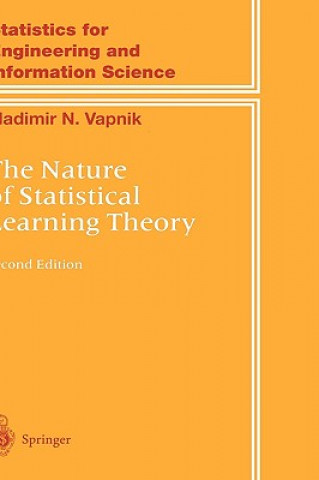
The aim of this book is to discuss the fundamental ideas which lie behind the statistical theory of learning and generalization. It considers learning as a general problem of function estimationbased on empirical data. Omitting proofs and technical details, the author concentrates on discussing the main results of learning theory and their connections to fundamental problems in statistics. These include: the setting of learning problems based on the model of minimizing the risk functional from empirical data a comprehensive analysis of the empirical risk minimization principle including necessary and sufficient conditions for its consistency non-asymptotic bounds for the risk achieved using the empirical risk minimization principle principles for controlling the generalization ability of learning machines using small sample sizes based on these bounds the Support Vector methods that control the generalization ability when estimating function using small sample size. The second edition of the book contains three new chapters devoted to further development of the learning theory and SVM techniques. These include: the theory of direct method of learning based on solving multidimensional integral equations for density, conditional probability, and conditional density estimation a new inductive principle of learning. Written in a readable and concise style, the book is intended for statisticians, mathematicians, physicists, and computer scientists.


Informacje o książce
Angielski
Kategoria

Podaruj tę książkę jeszcze dziś
To łatwe
1 Dodaj książkę do koszyka i wybierz „dostarczyć jako prezent” 2 W odpowiedzi wyślemy Ci bon 3 Książka dotrze na adres obdarowanegoMogłoby Cię także zainteresować
















 /
Twarda
105.01
zł
/
Twarda
105.01
zł


Cześć! Jestem Libroamiko, Twój doradca książkowy.
Jak mogę Ci pomóc?