
 Kontakt
 Jak kupować

Dostawa
Doradca ds. zakupów
 Angielski
 48 b
 Nowość
najlepszej
ceny ▸
Nawet do 30 dni na zwrot

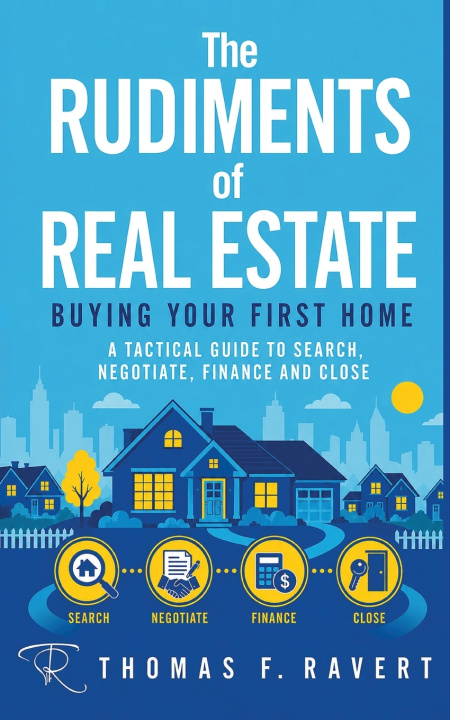
The Rudiments of Real Estate: Buying Your First Home - A Tactical Guide to Search, Negotiate, Finance, and Close is a practical, step-by-step guide to navigating the home-buying process with greater confidence and fewer costly mistakes.
Thomas F. Ravert, CFP®, draws on more than four decades of experience in real estate finance, lending, appraisal, underwriting, portfolio management, and financial planning to explain what happens after a buyer decides to enter the market. Rather than treating a home purchase as a series of disconnected tasks, Ravert shows how the pieces fit together-from preparing a competitive offer and conducting due diligence to choosing financing, satisfying underwriting requirements, and reaching the closing table.
The book begins with a critical discipline: separating emotion from financial judgment. Buyers learn how competition, enthusiasm, and fear of losing a property can lead to overpaying, stretching beyond a safe payment, or surrendering important contractual protections. Ravert's central message is simple: winning is not merely getting the house. It is acquiring a home you can afford, understand, protect, and comfortably own.
Readers learn how to structure and negotiate an offer by understanding purchase price, earnest money, financing, closing dates, proof of funds, and contingencies. The book explains why the highest offer does not always win and how timing, certainty, flexibility, and understanding the seller's priorities can sometimes be more valuable than simply offering more money.
Once a property is under contract, the focus turns to due diligence. Inspections, property condition, title, surveys, appraisals, taxes, association documents, insurance, environmental concerns, repairs, and future maintenance are explained in practical terms. An inspection does not simply "pass" or "fail" a house; it provides information. The buyer must decide whether the risks uncovered can be understood, reasonably priced, and accepted. Sometimes due diligence confirms the purchase, sometimes it creates leverage to renegotiate, and sometimes it shows the buyer when to walk away.
The financing section takes readers inside the mortgage process, explaining fixed- and adjustable-rate loans, conventional and government-backed mortgages, loan-to-value and debt-to-income ratios, mortgage insurance, points, rate locks, fees, and specialized financing structures. The right mortgage is not necessarily the one with the lowest advertised rate; it should fit the buyer's financial condition, expected ownership period, available cash, and tolerance for payment risk.
Readers are also shown what happens during underwriting and why documentation, consistency, transparency, and responsiveness matter. Ravert explains how lenders evaluate income, assets, credit, collateral, and other elements of the loan file, including the documentation commonly required from employees, self-employed borrowers, retirees, independent contractors, and commission-based borrowers.
Finally, the book guides buyers through the weeks leading to closing: resolving contingencies, satisfying lender conditions, reviewing the Closing Disclosure, arranging verified funds, completing the final walkthrough, confirming insurance, reviewing loan documents, and understanding how ownership transfers.
Throughout the book, technical concepts are translated into straightforward language and supported by practical examples drawn from real transactions. The goal is not to turn the reader into a real estate professional, but to provide enough knowledge to ask better questions, recognize unnecessary risk, understand the professionals involved, and remain in control of one of the largest financial transactions of their life.


Informacje o książce
Angielski

Podaruj tę książkę jeszcze dziś
To łatwe
1 Dodaj książkę do koszyka i wybierz „dostarczyć jako prezent” 2 W odpowiedzi wyślemy Ci bon 3 Książka dotrze na adres obdarowanegoCześć! Jestem Libroamiko, Twój doradca książkowy.
Jak mogę Ci pomóc?