
 Kontakt
 Jak kupować
Dostawa
Doradca ds. zakupów
The Story of Cooperstown
 Angielski
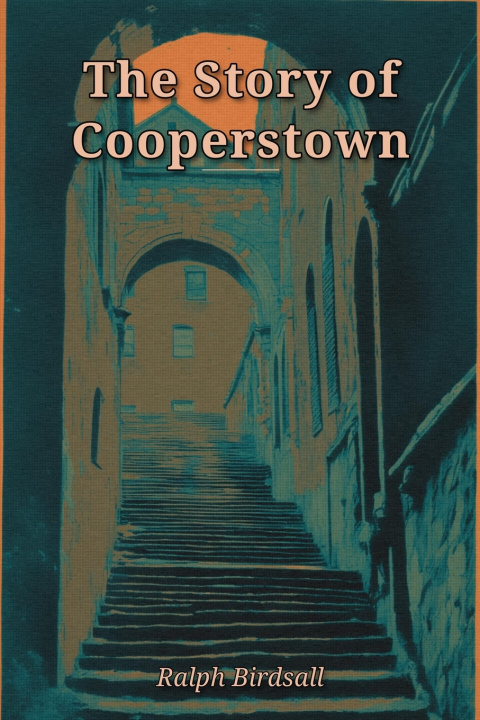
 Nowość

he main street of Cooperstown traverses the village in a direction gener-
ally east and west. While the street and its shops are far superior to those
of most small towns, the business centre, from which the visitor gains his
first impression, gives no hint of the quaint and rustic beauty that makes
Cooperstown one of the most charming villages in America.
Following the main street toward the east, one reaches the original part of
the settlement, and the prospect is more gratefully reminiscent of an old-
time village. In summer the gateway of the Cooper Grounds opens a pleas-
ing vista of shaded greensward, while the cross street which runs down to
the lake at this point attracts the eye to a half-concealed view of the Glim-
merglass, with the Sleeping Lion in the distance at the north.
The historical associations of the village, from the earliest times, are centered
in the Cooper Grounds. Within this space, when the first white man came,
were found apple trees, in full bearing, which Indians had planted, showing
an occupation by red men in the late Iroquois period. On these grounds the
first white settler, Col. George Croghan, built in1769 his hut of logs. During
3 RALPH BIRDSALL
the Revolutionary War it was upon this spot that Clinton's troops were en-
camped for five weeks before their spectacular descent of the Susquehanna
River. On this site William Cooper, the founder of the village, built his first
residence, and afterward erected Otsego Hall, which later became the home
of his son, James Fenimore Cooper, the novelist.
Beyond the Cooper Grounds, on the main street, the buildings seen on ei-
ther hand belong to the earlier period of village history, except the Village
Club and Library, which gracefully conforms to the older style. After pass-
ing the next cross-street, the main thoroughfare leads across the Susque-
hanna River, and, beyond the bridge, becomes identified with the old road
to Cherry Valley. Keeping on up the incline, one finds Mount Vision ris-
ing before him, and begins to gain fascinating glimpses into the grounds of
Woodside Hall, whose white pillars gleam amid the pines above the Egyp-
tian gate-tower, and whose windows, commanding the whole length of the
main street westward, reflect the fire of every sunset.
Just before reaching Woodside, one observes a road which makes off from
the highway at the right, and runs south. Opening from this road to Fernleigh-
Over, and quite close to the corner, is a small iron gate that creaks between
two posts of stone. The gate opens upon a path which leads, a few paces
westward, to a large, terraced mound, well sodded, and topped by two maple
trees.
Sunk into the face of this mound is a slab of granite which bears this inscrip-
tion:
WHITE MAN, GREETING!
WE, NEAR WHOSE BONES YOU STAND, WERE IROQUOIS. THE
WIDE LANDWHICH NOW IS YOURSWAS OURS. FRIENDLYHANDS
HAVE GIVEN BACK TO US ENOUGH FOR


Informacje o książce
Angielski

Podaruj tę książkę jeszcze dziś
To łatwe
1 Dodaj książkę do koszyka i wybierz „dostarczyć jako prezent” 2 W odpowiedzi wyślemy Ci bon 3 Książka dotrze na adres obdarowanegoCześć! Jestem Libroamiko, Twój doradca książkowy.
Jak mogę Ci pomóc?