
 Kontakt
 Jak kupować
Dostawa
Doradca ds. zakupów
 Angielski
 41 b
41 b
 Nowość
najlepszej
ceny ▸
Nawet do 30 dni na zwrot

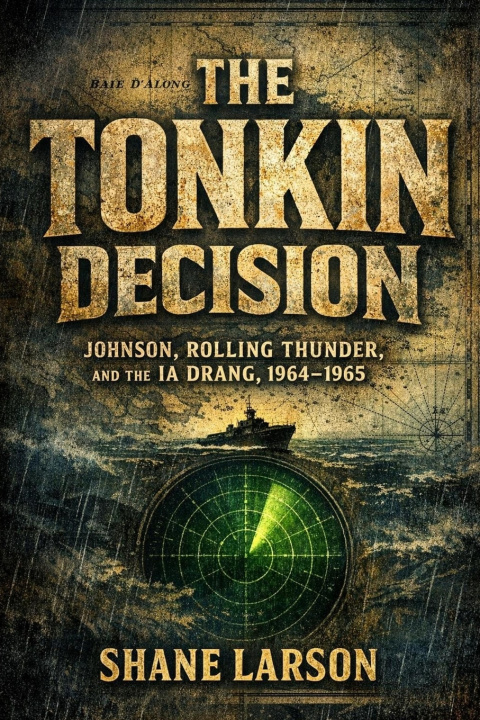
In eighteen months the United States went from sixteen thousand advisors to nearly two hundred thousand troops in combat - and the scale was chosen without ever being announced. The decision that committed the country to an open-ended ground war was presented as an increase of forty-four thousand men.
The record of how that happened is open, and it shows something more ordinary and more troubling than a conspiracy. On 2 August 1964, North Vietnamese torpedo boats attacked an American destroyer; that engagement happened. On the night of 4 August, in heavy weather, the same task group reported a second attack that the weight of the evidence - including the National Security Agency's own declassified reassessment - indicates never occurred. Within a week, Congress had authorized armed force on the strength of the incident that did not happen. This book keeps three questions separate throughout: what occurred on the water, what was reported up the chain, and what the decision-makers believed when they acted. No one had to lie for the machinery to produce a war authorization from a phantom battle. It worked as designed on bad information, which is worse.
The account holds both capitals on the page. In December 1963 - before Tonkin, before the bombing - Hanoi's Ninth Plenum decided to escalate, committing its regular army before the Americans could intervene in force. Both capitals spent 1964 choosing while believing they were reacting; a full chapter tells Hanoi's decision from the translated Vietnamese record. The book then follows the American decision through its stages: an election fought on a promise not to widen the war; a reprisal raid after Pleiku that became a bombing campaign of three and a half years; two Marine battalions landed to guard an airfield and conducting offensive operations within weeks; and the July 1965 meetings, from the published transcripts - including the decisions not to call up the reserves and not to seek a declaration, which shaped how the war was manned and financed. It ends in the Ia Drang valley, where the regular armies met for the first time and both commands concluded they could win.
What you'll learn:
- What the evidence establishes - and does not - about the nights of 2 and 4 August 1964
- What Hanoi's Ninth Plenum decided in December 1963, told from the Vietnamese record
- How the Tonkin resolution, drafted months before the incident, passed in three days and was used for eight years
- What the July 1965 meetings actually decided, and what the announcement left out
- Why both sides read the Ia Drang as a battle they had won, and what each did next
This book is for you if:
- You want the Gulf of Tonkin handled with precision - neither the official account nor a conspiracy theory
- You want both capitals on the page, with contested figures given as ranges and a named source at each end
- You want 1964-65 from the documents: the Pentagon Papers, the Johnson tapes, the declassified record
The Tonkin Decision is Volume 3 of The Vietnam War Chronicles, an eight-volume history from the Japanese occupation of Indochina to the fall of Saigon. The Introduction recaps the war so far - it stands alone.
The war's scale was chosen in these eighteen months. It was never announced.


Informacje o książce
Angielski

Podaruj tę książkę jeszcze dziś
To łatwe
1 Dodaj książkę do koszyka i wybierz „dostarczyć jako prezent” 2 W odpowiedzi wyślemy Ci bon 3 Książka dotrze na adres obdarowanegoCześć! Jestem Libroamiko, Twój doradca książkowy.
Jak mogę Ci pomóc?