Darmowa dostawa dla zamówień powyżej 299,00 zł.

Zostań członkiem wspólnoty miłośników książek z całego świata i zyskaj mnóstwo korzyści.
Załóż konto bezpłatnie
Darmowa dostawa z usługą Inpost oraz Orlen od 299.00 zł
DPD Kurier 12.99 zł
Poczta Polska 18.99 zł
Paczkomat 13.99 zł
InPost Kurier 12.99 zł
Punkt DPD 11.99 zł
 Kontakt
 Jak kupować
Pomoc
Dostawa
DPD Kurier 12.99 zł
Poczta Polska 18.99 zł
Paczkomat 13.99 zł
InPost Kurier 12.99 zł
Punkt DPD 11.99 zł
Darmowa dostawa z usługą Inpost oraz Orlen od 299.00 zł
Doradca ds. zakupów
Jesteśmy tu dla Ciebie!
(32) 444 93 66
Moje konto
▸
Pusty :-(
0
Darmowa dostawa dla zamówień powyżej 299,00 zł.
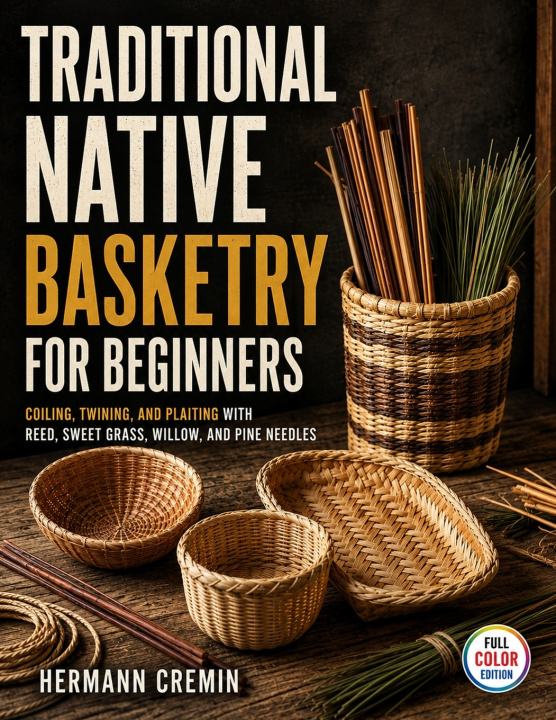
Traditional Native Basketry for Beginner
Coiling, Twining, and Plaiting with Reed, Sweet Grass, Willow, and Pine Needles
Język
 Angielski
Angielski
Książka
Miękka
Your first basket will probably come out a little uneven, and that is not a sign you did anything wr...
Cały opis
Kod Libristo: 53265062
?
 62 b
62 b
 Nowość
62 b
Nowość
Gwarancja
najlepszej
ceny ▸
najlepszej
ceny ▸
111.08
zł
Dostępna u dostawcy
Wysyłamy za 14-21 dni
Nawet do 30 dni na zwrot

Your first basket will probably come out a little uneven, and that is not a sign you did anything wrong. Almost everyone who has ever picked up a basketry awl has watched a coil drift off round or a strip buckle at a corner, and most were never told beforehand that unevenness is simply what learning looks like from the inside, row after row, for as long as anyone has been teaching it.
Three Techniques, Three Real Baskets
- Complete three full baskets: one coiled, one twined, one plaited
- Work reed, willow, sweetgrass, and pine needles, each prepared and cured correctly
- Catch a drifting coil on row four instead of unpicking row forty
- Finish rims and handles that hold up under years of daily use
- Read each material's own readiness instead of trusting a fixed soak time
- Grow from a first small bowl into structural, large-scale woven pieces
Why the Order Never Changes
Every chapter builds on the one directly before it. You learn coiling's core-and-stitch logic first, then twining's spoke-and-weaver logic, then plaiting's strip-over-strip logic, always through a first simple project before a second, harder one extends it. By the time the book returns to pine needles and sweetgrass for their own dedicated chapters, the mechanics are already second nature, so you can focus entirely on what makes each material particular to work with, rather than relearning the motion underneath it.
The Details That Save an Afternoon
- Splice new material with a tapered overlap so joins never show or fail
- Diagnose water damage and repair coiled, twined, and plaited pieces alike
- Design with color, texture, and proportion once the base techniques are set
- Build a repair kit that keeps every basket useful for years, not months
- Source sweetgrass respectfully from the artisans and regions it comes from
None of this requires a workshop or specialized machinery: a pair of scissors, an awl, and a blunt needle carry you through nearly every project inside. What changes is not your tools. It is the certainty in your hands once you understand why each technique behaves the way it does, certainty that shows in the first bowl and every one after it.
The materials list for your first coiled bowl is on page 33. Start there.
Aktorka
&
Poliglotka
EWA KASP
dla
Odtworzyć wideo


Libristo ma największy wybór literatury obcojęzycznej. Dlatego tutaj kupuję swoje książki.
Informacje o książce
Pełna nazwa
Traditional Native Basketry for Beginner
Autor
Hermann Cremin
Język
Angielski
Angielski
Oprawa
Książka - Miękka
Data wydania
2026
Liczba stron
142
EAN
9798187882717
Kod Libristo
53265062
Wydawnictwo
Independently published
Waga
348
Wymiary
216 x 280 x 8

Podaruj tę książkę jeszcze dziś
To łatwe
1 Dodaj książkę do koszyka i wybierz „dostarczyć jako prezent” 2 W odpowiedzi wyślemy Ci bon 3 Książka dotrze na adres obdarowanego
Doradca książkowy Libroamiko
Korzystając z czatu, komunikujesz się z generatywną sztuczną inteligencją. Tym samym wyrażasz zgodę na przetwarzanie danych osobowych.
Cześć! Jestem Libroamiko, Twój doradca książkowy.
Jak mogę Ci pomóc?
Cześć, jestem Libroamiko, w czym mogę pomóc?