
 Kontakt
 Jak kupować

Dostawa
Doradca ds. zakupów
 Angielski
 139 b
 Zapowiedź
 Nowość
Nawet do 30 dni na zwrot

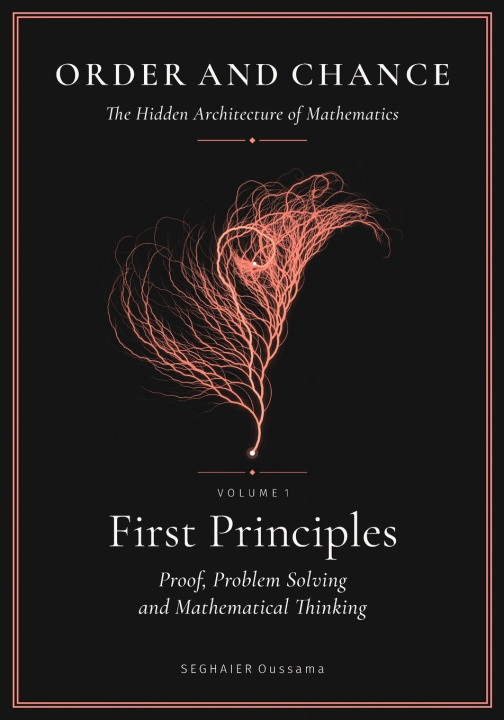
Order and Chance, Volume 1: First Principles
A surprising pattern is easy to spot. Proving it is another matter.
The first ten cubes add to 3025-the square of 1 + 2 + ... + 10. A few examples suggest a rule; they cannot establish it. This book teaches you how to ask the right question, choose a useful definition and build a proof that someone else can check. It also asks a different question: if four guests receive their hats in random order, how likely is it that nobody gets their own? One question is about certainty; the other is about chance. Both can be answered with mathematics.
First Principles is the starting point of Order and Chance: The Hidden Architecture of Mathematics, a fifteen-volume journey through the ideas that connect mathematical structure and randomness. The series moves from proofs and arithmetic to symmetry and probability; then through calculation, analysis and geometry to deeper randomness, number theory, and their eventual meeting. Each volume builds on the previous foundations. Volume 2, The Integers, carries the methods developed here into primes, congruences and equations in whole numbers. This first volume stands on its own.
Starting with secondary-school algebra and elementary geometry-not prior courses in proof, calculus or abstract algebra-you will learn to read quantified statements, test conjectures, use induction, count without double-counting, and turn numerical patterns into arguments. You will encounter sequences and limits, order relations, groups and subgroups, complex numbers and roots of unity, polynomials, linear algebra, calculus, inequalities and finite probability. Among the results developed are four proofs of the sum-of-cubes identity, the intermediate value theorem, Stirling's formula, the spectral theorem for real symmetric matrices, and the weak law of large numbers.
The chapters combine worked examples and proof-finding workshops with exercises graded from one to three stars. Every numbered exercise has a hint and a complete solution. Each solution separates how to find the idea from the final write-up. Optional advanced bridges are clearly signposted, so the main reading route remains accessible with a high-school foundation.
For curious readers, independent learners and anyone who wants to know not just that a formula works, but why.


Informacje o książce
Angielski
Kategoria

Podaruj tę książkę jeszcze dziś
To łatwe
1 Dodaj książkę do koszyka i wybierz „dostarczyć jako prezent” 2 W odpowiedzi wyślemy Ci bon 3 Książka dotrze na adres obdarowanegoCześć! Jestem Libroamiko, Twój doradca książkowy.
Jak mogę Ci pomóc?