
 Kontakt
 Jak kupować
Dostawa
Doradca ds. zakupów
Woodworking Math
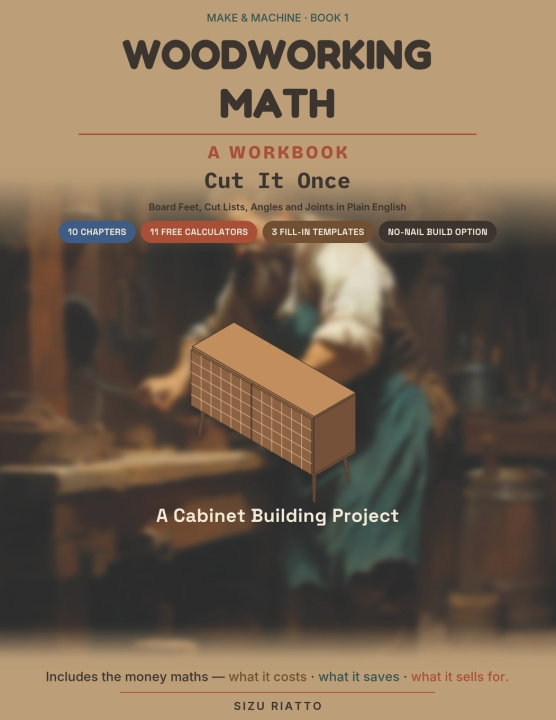
Cut It Once: Board Feet, Cut Lists, Angles and Joints in Plain English - Build a Real Piece of Furniture from Numbers You Worked Out Yourself
 Angielski
 40 b
40 b
 Zapowiedź
 Nowość
Nawet do 30 dni na zwrot

Most woodworking books hand you a plan. This one hands you the arithmetic behind the plan - so when you want the cabinet six inches wider, you do not need anybody's permission.
You will build a mid-century sideboard. Its entire plywood carcase comes out of one 8 × 4 sheet, it stands on four tapered legs splayed in two directions at once, and its shelf is sized not to sag. You will build it at whichever of three sizes fits your room - because the maths is what lets you change the size.
Who this is for: woodworking beginners and weekend hobbyists, self-taught makers and craft enthusiasts, anyone who has bought a second sheet of plywood because the first came up an inch short - and anyone who would rather design than just follow a plan.
Ten chapters, ten numbers, one cabinet:
- Board feet - what a board is actually worth, and why the size on the label is not the size in your hand
- Cut lists and kerf - why three 16-inch strips do not come out of a 48-inch sheet, and how to nest a whole carcase into one
- Square - the diagonal check, how far out of square you really are, and why matching parts beats accurate parts
- Dividing space - shelf pins, dividers and drawer banks, and the fence-post trap that catches everybody once
- Joints by proportion - write every joint as a fraction and you never look up a size again
- Mitres - half the corner, every time; and the trick that makes an inaccurate saw cut a perfect frame
- Compound angles - two five-degree leans make 7.05, not ten, and here is exactly why
- Spans and sag - double a span and the sag goes up eight times, and glued layers are n squared stiffer than loose ones
- The surface - the grit ladder as arithmetic, how thin a plywood veneer really is, and the sum that turns a tin's coverage figure into a film thickness and a number of coats
- The Build - the whole cabinet, using every chapter's number once, in order
Includes the money maths. Every chapter carries a separate, clearly-boxed section working out what it costs, what it saves, and what it sells for - for a one-off project, a hobby, a side-hustle, or a business. It is deliberately walled off, so if you only want to build the cabinet you can skip every one of them and nothing else in the book depends on it.
Two ways to build it, and you choose. Have the lumber yard cut the sheet, use one saw, or a full shop - all three finish the same cabinet, costed out for each. Then: the fastened build, or the nail-free build, which has no metal in it at all - dados, grooves, wedged tenons, sliding doors, and optional kumiko lattice panels held together by nothing but accuracy.
Every chapter ends with a Build Step you fill in - do them all and you have a cut list, a nesting plan and a shopping list for real furniture - plus a graded practice set with a full answer key that walks the reasoning, not just the number. Three fill-in templates at the back, including a true-to-scale sheet-nesting grid. Free companion online calculators.
Measure it, then do it once.
This book was written in collaboration with AI tools and verified by the author. Every number in it - every board foot, angle, deflection and price - is recomputed from first principles by an automated arithmetic harness, and the book does not go to print unless all 389 checks pass.
This book teaches arithmetic, not procedure. It tells you what the numbers say; it does not teach machine technique and is not a substitute for your tool manuals or for learning to use them safely. All prices are illustrative and dated, shown beside a blank for your own. Nothing here predicts what you will earn.


Informacje o książce
Angielski
